Do you dispatch for walk-in cooler emergencies during restaurant service hours?
Yes, and this is one of the most common commercial HVAC emergencies we respond to. Walk-in cooler compressor failure during Friday or Saturday dinner service is a food-loss emergency. Our commercial refrigeration technicians carry evaporator fan motors, condenser fan motors, defrost timers, thermostatic expansion valves, and common compressor contactors for Hussmann, Heatcraft, and Bohn systems in truck inventory. We document case temperatures on arrival and departure for your food-safety records.
What happens if our exhaust hood or make-up air fails during dinner service?
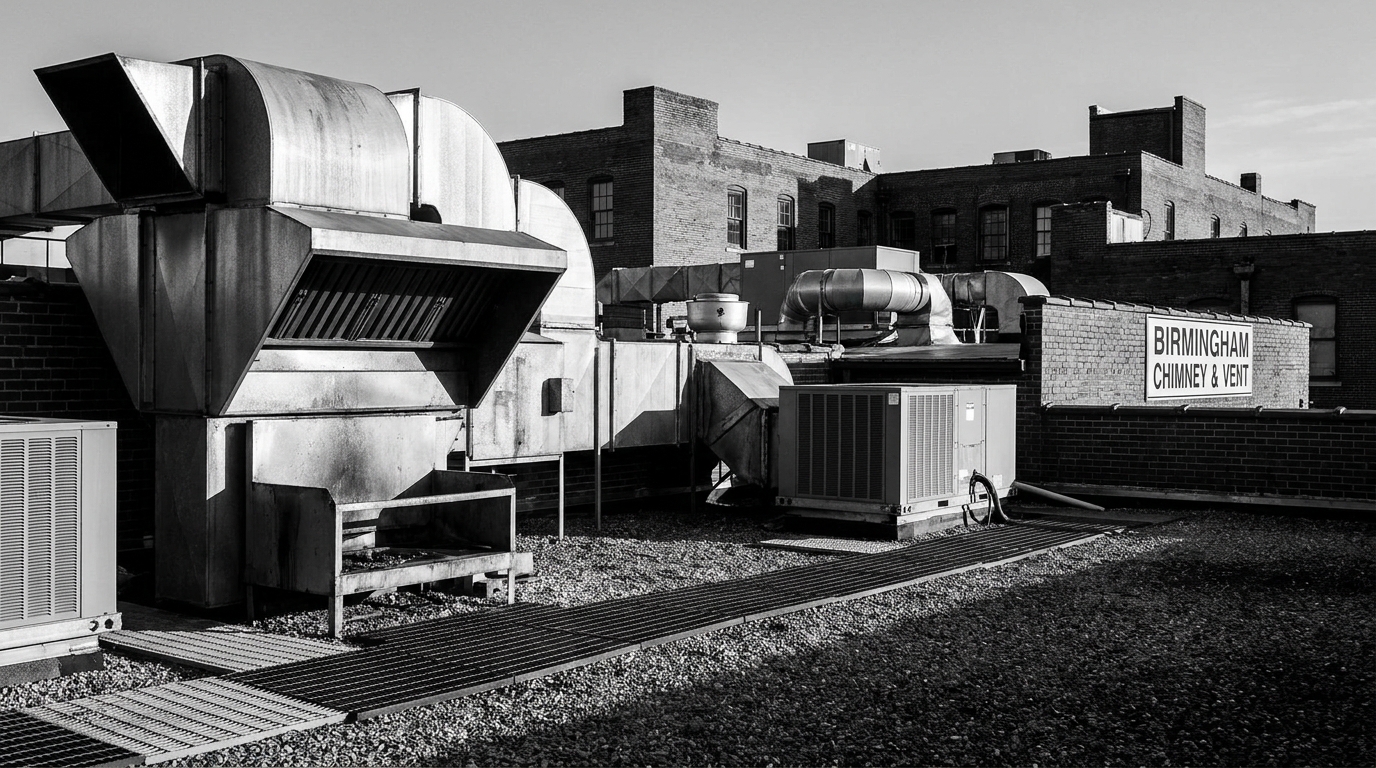
An exhaust-hood or make-up-air failure during dinner is a stop-service event because the kitchen fills with smoke, violating health code and creating fire exposure. We dispatch priority for make-up air and exhaust hood calls. Our technicians service Greenheck, Captive-Aire, Reznor, and Modine make-up air, and we understand the NFPA 96 commercial cooking ventilation code framework. For grease-related failures we coordinate with certified hood-cleaning vendors as the root-cause resolution.
Can you handle commercial refrigeration across Hussmann, Heatcraft, and Bohn systems?
Yes. These three platforms dominate Birmingham restaurant refrigeration. Our refrigeration technicians are trained on Copeland and Emerson compressor platforms and carry the common failure components in truck inventory. For large walk-in installations with refrigerant charges approaching the 50-pound EPA Section 608 Clean Air Act threshold, we document refrigerant handling and leak-repair per reporting requirements.
Do you serve multi-unit restaurant groups with portfolio contracts?
Yes. Multi-unit operators and national chains with Birmingham locations benefit from portfolio preferred-vendor contracts that standardize dispatch across every managed location. We scope those contracts around the actual equipment installed at each store — refrigeration inventory, RTU model and age, make-up air configuration — rather than a generic service-agreement template, and we invoice in a consolidated structure that matches how multi-unit operators reconcile accounts.
What is your after-hours process for restaurant emergencies?
Our dispatch line is staffed 24 hours a day by a coordinator, not an answering service. After-hours restaurant calls route directly to the on-duty commercial refrigeration or RTU technician depending on the equipment class in trouble. For an active walk-in cooler down during service, we prioritize the call and the coordinator confirms dispatch by phone within minutes so your GM knows travel time.
Do you work on commercial kitchen ice machines and prep refrigeration?
Yes, on the refrigeration side. We service Manitowoc, Scotsman, and Hoshizaki ice machines for refrigerant leaks, compressor failures, and condenser issues — the HVAC-side of the equipment. For water treatment, scale buildup, or potable-water issues we refer to a plumbing contractor. For reach-in refrigeration and prep tables we service True, Delfield, and Continental on the same commercial refrigeration platform.
Can you help with preventive maintenance scoped for restaurant equipment?
Yes. Restaurant preventive maintenance looks different from office building PM — the priority is commercial refrigeration monitoring, make-up air and exhaust hood system checks, NFPA 96 documentation, and RTU filter and coil service scheduled around slow seasons rather than peak service. We scope PM contracts per location with service intervals tuned to equipment load — a high-volume bar-and-grill with heavy refrigeration use warrants quarterly service, where a coffee shop may be semi-annual.
Do you coordinate with the local health department for HVAC-related inspection issues?
We coordinate on the HVAC side of the inspection when the issue is make-up air sizing, exhaust hood certification, or refrigeration temperature logs. For the food-code compliance layer we defer to your food safety consultant or Alabama Department of Public Health inspector. What we document on our service tickets — refrigerant type and amount, case temperatures on arrival and departure, make-up air certification — is written to support the inspection paper trail your health department records need.
What paperwork do restaurants need from us for vendor onboarding?
Standard commercial vendor onboarding package: Alabama HVAC contractor license documentation, Certificate of Insurance naming the restaurant owner or operating entity as additionally insured (coverage limits typically $1M general liability and $1M auto minimum), W-9, EPA Section 608 certification documentation for the dispatched technician, and Alabama Department of Public Health vendor-facing documentation if your health inspector wants a paper trail on HVAC service work.
What should a restaurant HVAC maintenance contract specifically include?
Restaurant PM contracts differ from standard commercial. Include: quarterly (or bi-monthly for high-volume bars) commercial refrigeration service, quarterly make-up air and exhaust hood inspection per NFPA 96 scope, RTU service scheduled around slow-season windows not peak, case-temperature documentation on every refrigeration visit for food-safety records, refrigerant leak-check documentation for systems approaching Section 608 reporting thresholds, and written equipment condition reports filed by email with both GM and owner.
How does emergency dispatch escalation work during active dinner service?
A dinner-service emergency call gets priority routing. The coordinator confirms dispatch by phone within minutes of the call, routes to the on-duty commercial refrigeration or RTU technician, and stays on the line with the GM through dispatch confirmation. We do not publish a response-time guarantee because travel distance and equipment class vary — what we commit to is an honest travel-time estimate you can use to decide whether to continue service, close early, or pull reservations.
Do multi-unit restaurant operators want a corporate facilities escalation path or direct-to-location?
Depends on the operator. Most multi-unit operators route emergency dispatch through a corporate facilities coordinator for accounting and reporting consistency, but the actual technician communication runs directly with the store GM during the dispatch window. Our contracts scope both paths — email confirmation to corporate facilities for records, phone communication with on-site GM for diagnosis and restore decisions.
Is refrigerant responsibility on the restaurant owner or the contractor?
Restaurant owner or operating entity holds compliance responsibility under EPA Section 608 Clean Air Act for refrigeration systems exceeding 50 pounds charge — which covers most full-service walk-in and reach-in installations. We document refrigerant type, amount on system, amount recovered, amount added, and leak-check results on every service ticket so your operations team has the paper trail for annual leak-rate tracking and the 3-year recordkeeping requirement.
What warranty tracking do you provide on installed restaurant equipment?
For commercial refrigeration and HVAC equipment we install, we track manufacturer warranty period, extended-warranty coverage, and third-party labor warranty on the service ticket record. For equipment installed by a prior vendor, we document warranty status at the first PM visit and flag covered items before recommending repair work so the operating entity can claim warranty against the original installer.
Are your techs actually Alabama licensed and EPA 608 certified?
Yes, factually. Work is performed under our licensed Alabama contractor, John M. King (Alabama HVAC Contractor License #2020068), and every technician dispatched on commercial HVAC and refrigeration work holds an active EPA Section 608 Universal certification. License status is verifiable against the Alabama Board of Heating, Air Conditioning, and Refrigeration Contractors public license system. We do not claim "factory authorized" for any manufacturer unless verified through direct manufacturer credentials.
Do you document service work in a format Alabama Department of Public Health inspectors accept?
Yes. Our service tickets document the HVAC-side information health inspectors reference — refrigeration case temperatures on arrival and departure, make-up air certification, exhaust hood capture verification, refrigerant documentation. For food-code compliance questions we defer to your Alabama Department of Public Health inspector or food-safety consultant, but our service records are structured to support the inspection paper trail.
Can you dispatch for new-location restaurant HVAC commissioning?
Yes. New-location commissioning is a scheduled service rather than emergency dispatch. We coordinate with the general contractor or tenant-improvement firm, document equipment installation, run commissioning tests against manufacturer spec, verify refrigerant pressures, validate exhaust hood and make-up air balance per NFPA 96, and file commissioning documentation for the operations opening file.
Do you service commercial kitchen equipment beyond refrigeration — ovens, ranges?
No. Our scope is commercial HVAC and commercial refrigeration — RTUs, chillers, VRF, walk-in cooler/freezer, reach-in refrigeration, make-up air, commercial kitchen exhaust on the mechanical side. Gas ranges, convection ovens, fryers, combi ovens, and dish-machines route to commercial kitchen equipment specialty vendors. We focus on the HVAC and refrigeration lane exclusively.