Imaging suites, exam rooms, specialty practices, dental and orthodontic offices, urgent care, and ambulatory surgical centers. Tighter humidity bands, infection-control documentation, and tenant-comfort expectations that do not tolerate downtime.
Birmingham's medical office building inventory runs a mix of equipment configurations. Smaller specialty practices and dental offices in suburban medical office buildings — Cahaba Heights, Greystone, Hoover, Vestavia — typically operate on 3-to-8-ton split systems or small packaged rooftop units, often one per suite with the tenant carrying the maintenance responsibility. Larger multi-tenant medical office buildings near UAB and St. Vincent's run on built-up air handling units, often with chilled water from a central plant, distributed through VAV boxes per suite. Ambulatory surgical centers and imaging facilities frequently have dedicated dehumidification equipment and tighter zoning.
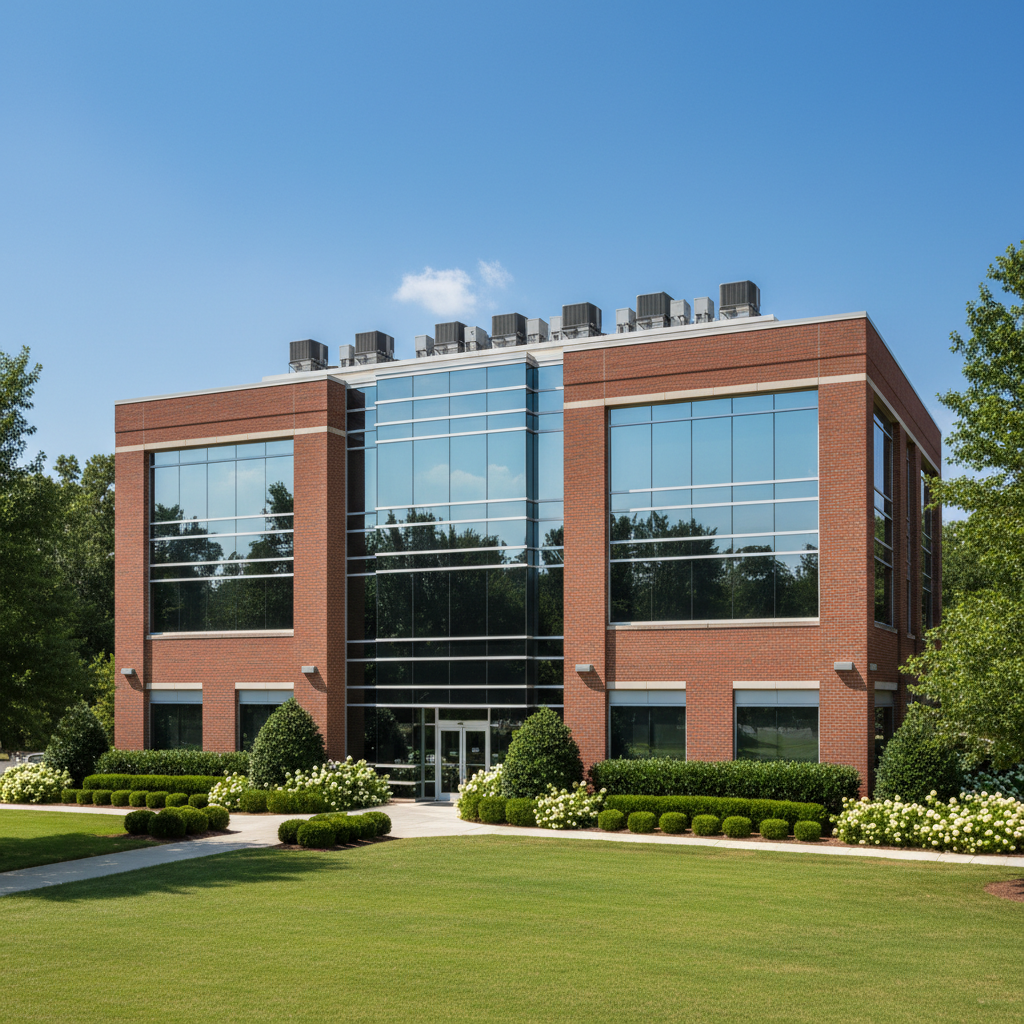
The equipment scope we service in Birmingham medical office buildings: packaged rooftop units 3 to 25 tons, commercial split systems with high-efficiency filtration, VAV terminal units with reheat, built-up air handling units with chilled water coils, dedicated outdoor air systems (DOAS) on newer construction, and humidity-control equipment for imaging suites and operating rooms. The technicians dispatched to medical office calls are EPA Section 608 certified and have specific commercial experience — we do not send residential-trained technicians into medical environments.
Birmingham's climate complicates the medical office HVAC job. Köppen Cfa humid subtropical climate means summer dew points routinely hit 70 to 74 degrees. Medical environments often require 40 to 60 percent relative humidity year-round. The HVAC system has to do real work to land the building inside that band, and the documentation has to prove it on every inspection visit.
The reason medical office HVAC is a different job is documentation. An ambulatory surgical center under accreditation review will be asked for HVAC maintenance records covering air-change rates, filter inspection and replacement intervals, pressure-relationship verification between clean and dirty spaces, and humidity logs for affected zones. A dental practice operating under state board oversight will be asked similar questions. An imaging facility will be asked about humidity-control logs for the equipment manufacturer's tolerance band.
We write our medical office HVAC service tickets with that documentation in mind. Every visit produces a written record covering the equipment serviced, the readings observed, the work performed, and the next inspection interval. Refrigerant pressures get logged. Filter changes get logged with the differential pressure reading at the new filter. Humidity setpoints and observed performance get logged. The paper trail is built for the accreditation survey, not for our convenience.
The relevant standards in the medical office HVAC scope: ASHRAE Standard 170 — Ventilation of Health Care Facilities for facilities under that scope, ASHRAE Standard 62.1 for general indoor air quality, ASHRAE Standard 180 for preventive maintenance scope, and the building manufacturer's humidity-control specifications for imaging and laboratory equipment. We work to these standards as a matter of course, not as an upcharge.
The most common medical office HVAC complaint we hear in Birmingham is humidity. The temperature is correct but the room feels clammy, the imaging equipment is throwing humidity alarms, the front desk is fielding patient complaints, or the lab equipment is operating at the edge of its environmental tolerance. The thermostat reads 72 degrees and the room feels wrong.
The diagnostic logic is consistent. A commercial cooling system meets the latent load — the moisture removal — by running the cooling coil cold enough and long enough to condense water out of the airstream. When the system is oversized, it cools the air to setpoint quickly and shuts off before pulling enough moisture out. When the system is undercharged on refrigerant, the coil never gets cold enough to do the latent work. When the supply airflow is too high, air moves across the coil too fast to lose its moisture. Each of these has a different fix.
For medical office buildings that require year-round tight humidity control, the solution is often a dedicated outdoor air system with explicit dehumidification, a hot-gas reheat coil for low-load conditions, or an enthalpy-recovery wheel pretreating outside air. We diagnose against actual readings — supply air dew point, return air dew point, refrigerant pressures, and coil temperature differential — not against guesswork. Read our analysis on VRF systems in commercial office buildings for the equipment-comparison framework.
Medical office HVAC failures cannot wait for the next business day. A specialty practice running clinic on Saturday morning with no air conditioning cancels appointments, costs revenue, and damages the practice's reputation. An ambulatory surgical center with humidity drift loses its operating window. A dental office with an HVAC failure during patient hours has limited options beyond rescheduling or moving the schedule to another location.
We dispatch 24 hours a day for medical office emergencies. The coordinator routes a technician with the equipment-specific knowledge needed — the technician for a built-up air handling unit on a central chilled water plant is not the same technician for a 5-ton split system in a suburban suite. We match the call to the technician. For multi-tenant medical office buildings, we coordinate with the property management team on access, after-hours building entry, and tenant communication.
Documentation continues on emergency visits. Every after-hours service ticket produces the same written record as a scheduled PM visit — equipment serviced, readings taken, work performed, parts used, and next inspection interval. The accreditation file does not have a separate folder for emergency repairs.
A medical office HVAC preventive maintenance contract carries a different scope than a general commercial contract. The visit frequency is typically quarterly at minimum — many specialty practices and surgical centers run on monthly inspection cycles. The scope includes filter change verification with differential pressure logging, humidity setpoint verification, pressure-relationship verification between clean and dirty spaces where applicable, condensate drain inspection (a common source of indoor air quality complaints in humid climates), and refrigerant leak check on systems above the EPA Section 608 reporting threshold.
We write the contract against the actual equipment list and the actual compliance requirements of your practice or facility. A specialty practice in a 4,000 square foot suburban suite has a different scope than a 35,000 square foot ambulatory surgical center. The pricing reflects that. We do not offer a generic medical office PM template.
Review our contract guide before signing with any vendor and download the commercial compliance checklist PDF as a starting framework for your facilities file.
Service tickets dispatched by a human coordinator. Documentation written for the facilities file, not for the marketing brochure. Commercial-only service across Birmingham, Hoover, Vestavia, Pelham, Trussville, Alabaster, McCalla, and the broader Jefferson County and Shelby County metro.
Commercial HVAC only. Submit the form and a dispatch coordinator follows up by email. For active outages, call (205) 206-6606.
We email confirmation within business hours. For active outages, call the line above.