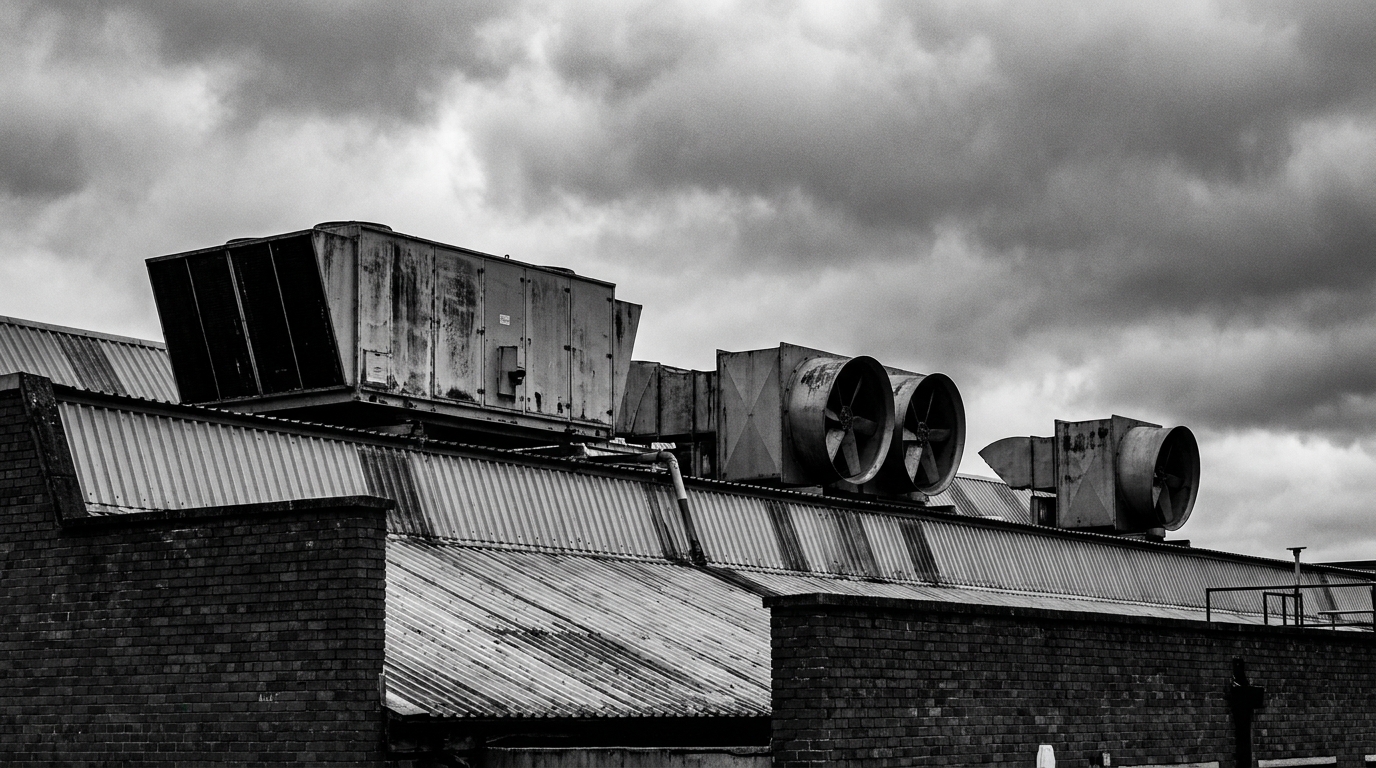
Do you service large-format make-up air units on warehouse and production facilities?
Yes. Make-up air is our highest-volume light-industrial service category. We dispatch for Reznor, Modine, Ouellet, Greenheck, and Captive-Aire direct-fired MUA and indirect-fired rooftop MUA on warehouse, distribution, and light-manufacturing facilities. Our trucks carry burner assemblies, gas valves, ignition controls, fan motors, and filter assemblies for emergency MUA dispatch.
Can you handle warehouse gas unit heater failures in the winter?
Yes. Warehouse unit heater dispatch is a winter-specialty service. We stock Modine, Reznor, and Sterling burner assemblies, ignition modules, gas valves, and blower motors through the November-to-March peak failure window. Warehouse heating failure in January is a production-continuity event and we prioritize dispatch accordingly.
Do you dispatch for office-portion RTUs inside warehouse buildings?
Yes. Most light-industrial facilities carry a built-out office space inside the warehouse envelope with 3 to 15-ton packaged RTUs. We dispatch for these on the same schedule as commercial office RTUs, with truck inventory covering Carrier, Trane, York, Lennox, and Rheem Commercial equipment common in light-industrial office build-outs.
Can you support process cooling on manufacturing equipment?
Yes, on a case-by-case basis. Process cooling dispatch depends on the specific equipment — chilled-water loops serving manufacturing equipment, direct-expansion process cooling, and specialty temperature-controlled environments. For standard commercial refrigeration on food processing or pharmaceutical storage, we dispatch under our commercial refrigeration service with EPA Section 608 compliance. For specialty process equipment we scope the work separately.
Do you handle refrigerated warehouse and cold storage facilities?
Yes, with the specialty refrigeration team. Refrigerated warehouses, cold storage, and food-processing facilities operate commercial refrigeration at a scale that exceeds standard commercial HVAC. These dispatches route to our refrigeration specialty technicians with EPA Section 608 Universal certification and the diagnostic inventory for large-charge refrigerant systems. For facilities subject to Clean Air Act leak-repair reporting (systems over 50 pounds), we handle the documentation protocol.
What is your response approach for production-line HVAC emergencies?
Production-line emergencies are our highest-priority light-industrial dispatch. The coordinator confirms dispatch by phone immediately, routes to the on-duty technician qualified for the equipment class, and maintains direct communication with the plant manager through resolution. We document arrival, diagnosis, and corrective work on the service ticket in a format that supports your production-continuity records and, where applicable, your OSHA safety-file documentation.
Can you scope preventive maintenance for multi-building industrial parks?
Yes. Industrial parks with multiple buildings under single ownership or management benefit from multi-building preferred-vendor contracts that cover every facility on scheduled service intervals. We scope the contract around the specific equipment at each building — some buildings heavy on MUA and unit heaters, some heavy on office RTUs, some with process cooling — rather than a generic template, and we invoice consolidated monthly per park.
Do you handle natural gas equipment certification and code compliance?
We handle the HVAC equipment side of gas-fired systems — burner assemblies, gas valves, ignition controls, combustion analysis, and manufacturer-spec installation. For primary gas-line work, regulators at the utility meter, or natural gas supply issues we coordinate with Spire or your facility plumbing contractor. Every gas-fired equipment service includes combustion analysis documentation and leak-check verification.
What vendor onboarding paperwork do industrial facilities require?
Industrial facility vendor onboarding is typically more detailed than commercial retail or office. Standard requirements include Alabama HVAC contractor license, Certificate of Insurance naming the operating entity as additionally insured at industrial-coverage limits (typically $2M GL, $2M auto, $5M umbrella, workers compensation), W-9, EPA Section 608 certification documentation, OSHA 10 or 30-hour safety training documentation for the dispatched technician, and facility-specific safety orientations (forklift awareness, confined-space, hot-work permits) before first dispatch.
What should a light-industrial HVAC maintenance contract explicitly cover?
Industrial PM contracts differ from commercial office. Cover: quarterly MUA and exhaust-fan inspection with combustion analysis on gas-fired equipment, semi-annual warehouse unit heater service scheduled for September pre-heating-season startup, office-portion RTU service on commercial office schedule (quarterly heavy-use, semi-annual low-use), process-cooling chiller service per equipment manufacturer schedule, refrigerant compliance documentation for systems over 50 lb charge, and written condition reports by equipment ID for the facility maintenance file.
How is after-hours dispatch handled for production-line emergencies?
Production-line emergencies get priority routing. Coordinator confirms dispatch by phone within minutes, routes to on-duty technician qualified for the equipment class (MUA, unit heater, process cooling, office RTU), and maintains direct communication with the plant manager or maintenance supervisor through dispatch and restore. Portfolio preferred-vendor accounts get priority across all after-hours calls. We do not publish production-line response-time guarantees — we commit to honest dispatch-or-decline so the plant can plan.
What is the escalation path when a weekend shift has a production HVAC failure?
Weekend production shifts route through the same 24/7 dispatch coordinator with priority confirmation for production-affecting failures. For preferred-vendor industrial accounts we pre-agree the escalation path — who calls whom, email chain triggers, documentation requirements — during contract scoping so weekend calls follow a defined protocol rather than ad-hoc communication.
Is refrigerant responsibility on the facility owner or the contractor?
Facility owner or operating entity holds compliance responsibility under EPA Section 608 for refrigerant-containing equipment exceeding 50 pounds charge. Industrial facilities often have large-charge refrigeration (refrigerated warehouse, process cooling, cold storage) that easily exceeds the threshold. We document refrigerant handling on every service ticket and provide the paper trail needed for annual leak-rate tracking and the 3-year recordkeeping requirement.
Do you provide equipment warranty tracking on industrial HVAC installations?
Yes. For new equipment we install, warranty tracking is documented on the service ticket record. For inherited equipment installed by a prior vendor, we document warranty status at the first PM visit and flag covered items before recommending repair work. Industrial equipment warranties can be complex (separate manufacturer, install-labor, and extended-coverage layers) and we map the coverage explicitly so your maintenance supervisor has the paper trail.
Are your technicians Alabama licensed and EPA 608 certified — verifiable?
Yes. Work is performed under our licensed Alabama contractor, John M. King (Alabama HVAC Contractor License #2020068), and every technician dispatched on industrial HVAC work holds an active EPA Section 608 Universal certification. License status is verifiable through the Alabama Board of Heating, Air Conditioning, and Refrigeration Contractors public license system. We also document OSHA safety training per technician for industrial vendor-onboarding workflows.
Can you coordinate with industrial facility safety and environmental teams?
Yes. Industrial dispatch frequently requires coordination with EHS (Environmental Health and Safety) and facility safety teams on hot-work permits, confined-space entry, lockout-tagout protocols, and refrigerant compliance reporting. Our technicians are trained on industrial safety protocols and we document every service event in a format that supports your OSHA recordkeeping and environmental compliance files.
What is the scope of process cooling work versus specialty industrial equipment?
We handle commercial process cooling on standard commercial refrigeration and chilled-water equipment — Trane, Carrier, York, Daikin chiller platforms; standard direct-expansion process cooling. For specialty industrial process equipment (cryogenic cooling, precision temperature control beyond commercial tolerance, semiconductor-grade environmental control), we scope the work against our capability or refer to industrial-specialty vendors. Honest scoping up front saves downstream problems.
Do you support multi-site industrial portfolio servicing?
Yes. Multi-site industrial portfolio contracts for operators with multiple Birmingham-metro or regional facilities run on one dispatch relationship, consolidated monthly invoicing per facility, standardized service reporting integrated with your maintenance management system (CMMS — Maximo, Infor EAM, SAP PM, Fiix), and equipment-specific PM scoped to each facility individually rather than generic template.
What do we need to know about AIM Act refrigerant phase-down for industrial equipment?
Industrial refrigeration and process cooling equipment falls under the EPA AIM Act HFC phase-down. Existing R-410A and R-134a equipment can be serviced indefinitely with allocated or reclaimed refrigerant. New commercial and industrial HVAC installations after January 1, 2025 in regulated categories will use R-454B, R-32, or approved lower-GWP alternatives. For large-charge industrial refrigeration, long-term planning should assume higher refrigerant costs in 2028-2032 under the continuing allocation reductions.