Do you offer portfolio contracts for property management firms?
Yes. Portfolio preferred-vendor contracts are a core part of our business model. We work with national firms operating in Birmingham (CBRE, JLL, Colliers, Cushman & Wakefield) and major local firms (Graham & Company, Harbert Management, Daniel Corporation, Crawford Square Real Estate, CAM Inc) on multi-property contracts that cover every managed building on a single dispatch relationship with consolidated monthly invoicing.
What does a portfolio contract include?
A portfolio contract typically includes: 24/7 emergency dispatch covering every managed property, preventive maintenance scoped to the actual equipment inventory at each building, priority response for preferred-vendor accounts, consolidated monthly invoicing organized by property with line-item breakout, written service reports that integrate with your maintenance software platform, end-of-life equipment replacement planning, and a single facilities-coordinator escalation path across all properties.
Can you handle multifamily property management alongside commercial?
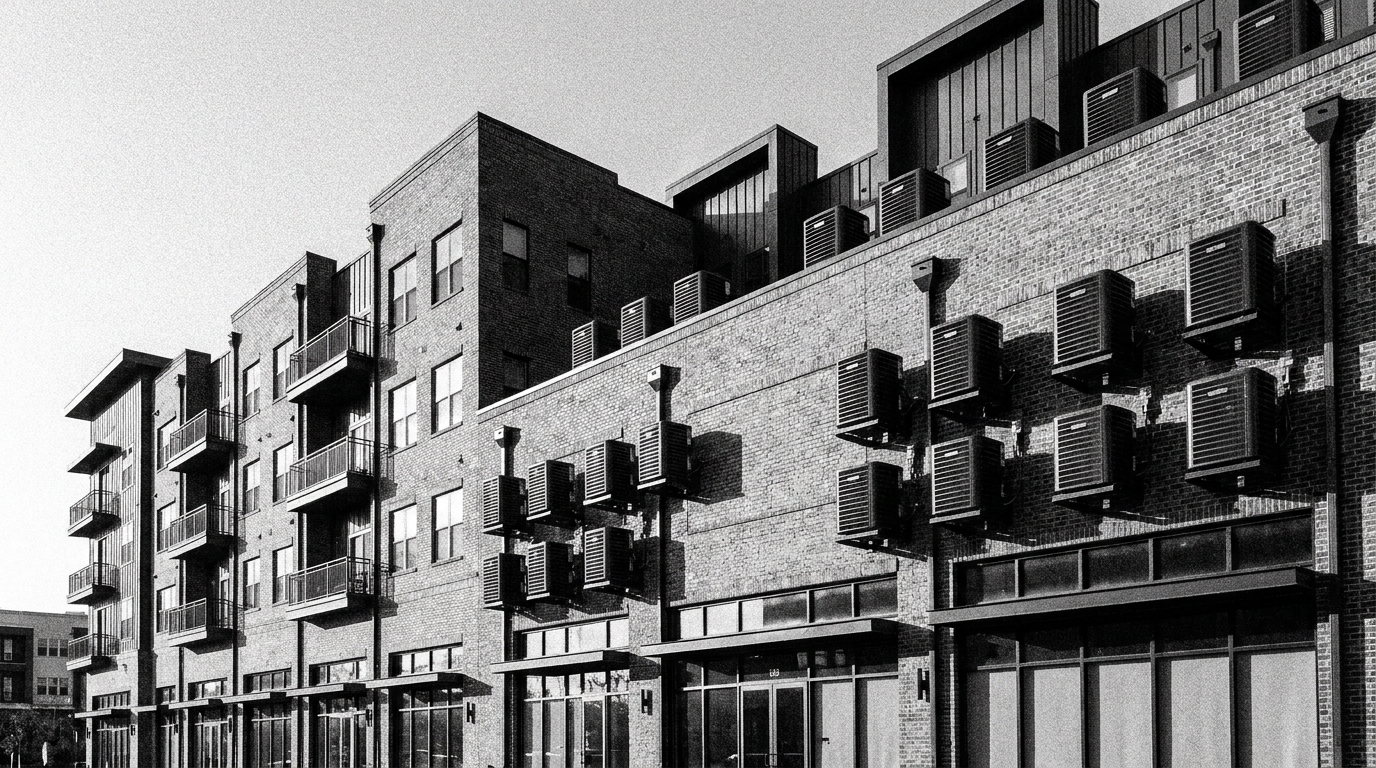
Yes. Many Birmingham property management firms operate mixed portfolios spanning multifamily, commercial office, and retail. We service all three equipment classes under a single contract. Multifamily carries per-unit split systems, common-area HVAC on clubhouse and amenity areas, and turn-unit inspection service. Commercial office and retail carry the equipment classes covered on our Offices and Retail vertical pages.
Do you document service events in a format that supports our property management software?
Yes. We integrate with the major property management software platforms (Yardi, AppFolio, RealPage, MRI) on the service-documentation side. Every service ticket includes the standardized fields your facilities software requires: property ID, equipment ID, service date, technician, problem description, corrective action, parts and labor, and follow-up recommendations. For firms running custom-built maintenance workflows we match the format your dispatchers need.
How do you handle affordable housing and HUD compliance documentation?
Affordable housing and Section 8 portfolios carry a compliance layer that ties HVAC records to habitability standards under HUD handbook guidelines. We document service events on these properties in a format that supports HUD compliance files — not just the mechanical service file. For REAC-inspected properties we structure documentation to align with the inspection protocol so facilities compliance officers have the paper trail they need.
What is your turn-unit HVAC inspection process for multifamily?
Turn-unit HVAC inspection is a scheduled service triggered by tenant move-out on multifamily portfolios. Within the property-manager-specified window between move-out and make-ready inspection, we dispatch for a full HVAC condition check — filter, evaporator coil, condenser coil, refrigerant pressure, electrical inspection, thermostat verification — and document condition with photos on the service ticket. The written condition report is filed with the property management firm for tenant-deposit reconciliation and make-ready planning.
Can you scope preventive maintenance across an entire managed portfolio?
Yes. Portfolio PM starts with a walk-through of every managed property with your facilities coordinator to inventory the equipment class, age, and service history at each building. We scope the PM cycle based on real equipment load — quarterly on heavy-use buildings, semi-annual on low-use buildings, with additional inspection visits for end-of-life equipment approaching replacement. Contract terms are written around the real equipment stack, not a generic template.
How do you handle holiday and weekend dispatch on managed portfolios?
Holiday and weekend dispatch for preferred-vendor portfolio accounts runs on priority routing. The dispatch coordinator confirms dispatch for managed-portfolio calls within minutes and routes to the on-duty technician qualified for the equipment class in trouble. For firms with a facilities-on-call rotation, we coordinate directly with the on-call property manager rather than routing every communication through corporate facilities.
What vendor onboarding paperwork do property management firms require?
Property management vendor onboarding typically requires: Alabama HVAC contractor license, Certificate of Insurance naming the ownership entity and management firm as additionally insured (coverage minimums typically $1-2M general liability, $1M auto, $2-5M umbrella for larger portfolios), W-9, EPA Section 608 certification for dispatched technicians, firm-specific vendor onboarding forms (background check authorization, safety training, subcontractor disclosures), and in many cases a signed Master Services Agreement rather than per-project contracts.
What should a property management portfolio HVAC contract specifically cover?
Portfolio contracts should specify: equipment inventory per property with make, model, serial number, refrigerant type, installation year, and warranty status; ASHRAE Standard 180 inspection protocol; service frequency tiered to equipment type and property class; labor and parts inclusions with explicit exclusions and dollar-value caps per property; emergency dispatch priority tier without response-time guarantees; consolidated monthly invoicing format; property-management software integration requirements; and 30-day renewal notice (not 90-day auto-renewal) with documented-service-failure exit triggers.
How is after-hours dispatch escalation handled for portfolio accounts?
Portfolio preferred-vendor accounts get priority dispatch routing. The coordinator confirms dispatch for portfolio calls within minutes of the call. Escalation paths are pre-agreed during contract scoping — which facilities coordinator or on-call property manager receives confirmation, what email chain triggers regional facilities escalation, how weekend and holiday coverage routes through your organization. We document the escalation protocol in the contract rather than relying on ad-hoc coordination.
What is the facility manager vs property manager vs asset manager decision-tier split?
Facility manager handles day-to-day operational dispatch, PM scheduling, and vendor coordination. Property manager handles building-level budget, lease administration, and vendor contract approval. Asset manager holds capital budget authority, end-of-life equipment replacement planning, portfolio-level vendor strategy, and ultimately signs portfolio contract renewals. Our dispatch runs through facility management; PM and emergency coordination through property management; portfolio contracting and replacement planning through asset management or corporate facilities.
Is refrigerant responsibility on the property owner, management firm, or contractor?
EPA Section 608 compliance responsibility sits primarily with the building owner or operating entity — typically the property ownership entity, not the management firm. For portfolio accounts, the ownership entity varies by building, so the compliance responsibility varies too. We document refrigerant handling on every service ticket with owner-entity identification so the paper trail lands in the correct compliance file for each building's ownership structure.
Can you provide warranty tracking integrated with our property-management software?
Yes. Equipment warranty tracking integrates with Yardi, AppFolio, RealPage, and MRI on the equipment-record side. For new installations, warranty status is documented at commissioning and flagged on the equipment record. For equipment installed by prior vendors, we document warranty status at the first PM visit and flag coverage before recommending repair work so the property manager can claim warranty against the original installer before approving out-of-pocket spend.
Are your technicians Alabama HVAC licensed and EPA 608 certified — verifiable?
Yes. Work is performed under our licensed Alabama contractor, John M. King (Alabama HVAC Contractor License #2020068), and every technician on every portfolio dispatch holds an active EPA Section 608 Universal certification. License status is verifiable through the Alabama Board of Heating, Air Conditioning, and Refrigeration Contractors public license verification system. For property management firms requiring vendor technician documentation, we provide credential documentation packages at contract onboarding and update annually on license renewal cycles.
What is the scope of commercial refrigeration work on multifamily amenities?
Multifamily common-area refrigeration — clubhouse kitchen walk-ins, bar-area reach-ins, amenity-space refrigeration — is handled under our commercial refrigeration scope. For luxury multifamily with full amenity kitchens, we service the refrigeration side on the same platforms as restaurant and commercial refrigeration (Hussmann, Heatcraft, Bohn with Copeland/Emerson compressors) with standard EPA Section 608 compliance documentation on every service ticket.
Can you support multi-site portfolio servicing across multiple regions beyond Birmingham?
Primary service area is Birmingham-metro Alabama (Jefferson, Shelby, St. Clair counties). For multi-region portfolio firms with a Birmingham concentration plus adjacent markets (Tuscaloosa, Huntsville, Montgomery), we can scope Birmingham as primary with referral partners for adjacent markets on a contract basis. For national-portfolio firms, Birmingham is our service territory; we integrate into a national vendor list rather than replacing one.
How do you handle ADA and fair-housing compliance documentation on multifamily HVAC?
Fair-housing compliance on multifamily HVAC ties into HUD handbook habitability standards and the firm's internal fair-housing policy. We document service events — especially comfort-complaint response timing and thermostat accessibility — in a format that supports fair-housing file recordkeeping. For specific disability-accommodation HVAC modifications (accessible thermostat placement, hearing-impaired alarm integration), we coordinate with your fair-housing coordinator on scope.