Retail Vertical · Birmingham, AL

Retail store HVAC, sized for the foot-traffic side of the lease.

Strip centers, lifestyle centers, shopping malls, big-box anchors, and single-tenant retail boxes. Tenant comfort, peak-season dispatch, multi-tenant RTU portfolios, and shared common-area cooling.

TL;DR. Retail HVAC in Birmingham is a tenant-comfort and revenue-continuity problem. A 5-ton rooftop unit down on a Saturday afternoon at a busy strip center costs traffic, costs sales, and costs the lease relationship. Emergency HVAC Repair Pros services Birmingham retail HVAC — strip centers, shopping malls, big-box anchors, single-tenant retail boxes — with multi-tenant portfolio contracts and 24-hour dispatch. Call (205) 206-6606 for an active outage or to scope a property-management contract.

The retail HVAC stack we service in Birmingham.

Birmingham's retail inventory runs a mix of building types. Suburban strip centers — Hoover, Trussville, Pelham, Alabaster, McCalla — typically run dedicated packaged rooftop units per tenant suite, sized 3 to 7.5 tons depending on the suite. Lifestyle centers and mall in-line tenants run a mix of dedicated and shared HVAC, often with landlord-furnished common-area cooling and tenant-furnished suite cooling. Big-box anchors run multiple large packaged RTUs, often 7.5 to 25 tons each, with built-up air handling for the largest formats. Single-tenant retail boxes — automotive parts, drugstores, fast-casual restaurants in retail format — run dedicated packaged equipment.

The brands and refrigerants we see most across Birmingham retail: Carrier, Trane, York, Lennox, Daikin, and Goodman packaged RTUs across R-410A and R-454B. Legacy equipment on R-22 is still in service on retail buildings constructed before 2010 — we service it but we will discuss lifecycle planning on R-22 equipment past year 12 given the reclaimed-refrigerant supply situation. Equipment scope includes packaged RTUs 3 to 25 tons, split systems for older buildings or unusual tenant configurations, and built-up air handling for large-format big-box buildings.

The technicians dispatched to retail calls in Birmingham carry EPA Section 608 certification, Alabama state HVAC licenses, and the commercial truck inventory for the equipment scope. We are licensed, bonded, and insured for commercial work in Alabama. We provide certificate of insurance documentation directly to property management on request.
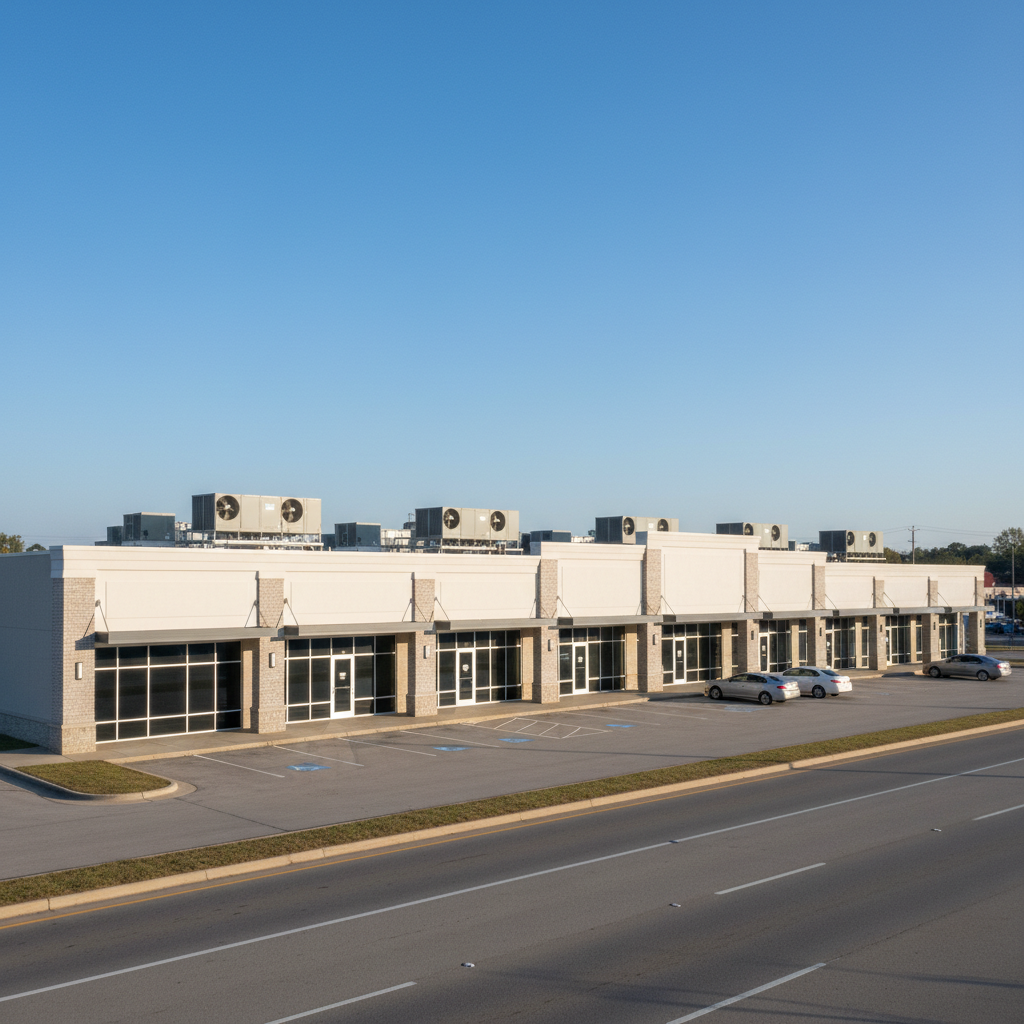
Peak-season dispatch and tenant-comfort triage.

Retail HVAC failures cluster in Birmingham's peak summer cooling season — late June through early September — when ambient temperatures push 95 degrees and dew points run 72 or above. A rooftop unit that has been running with a fouled condenser coil through April and May fails on the first 95-degree afternoon. This is not a coincidence. Birmingham retail buildings see a measurable spike in emergency calls in the first week of sustained heat.

The triage protocol on a peak-season retail call: get the tenant comfortable first. If the rooftop unit is repairable on the truck — capacitor failure, control board failure, contactor failure — we make the repair and verify operation under load. If the failure is a compressor or coil event, we move the tenant to portable cooling assist where the lease permits, scope the parts and labor for the repair or replacement decision, and communicate the timeline back to the property management team. We do not leave a tenant guessing for three days.

For property managers operating multiple retail centers in Birmingham, the peak-season dispatch math is portfolio-wide. We prioritize occupied retail space over vacant common areas, occupied tenant suites over storage and back-of-house, and high-traffic anchor tenants over lower-traffic in-line tenants where the lease permits. The triage logic is documented in the portfolio contract scope.

Multi-tenant retail portfolios and the lease question.

The dividing line between landlord HVAC responsibility and tenant HVAC responsibility is the lease, not the equipment. A standard triple-net retail lease usually puts the dedicated suite RTU on the tenant for maintenance and repair, with the landlord covering common-area HVAC and the building envelope. A modified gross lease may move some or all of the HVAC responsibility back to the landlord. Master leases on big-box anchor formats often carry custom terms.

We work either side of the lease. Property managers operating Birmingham retail portfolios get a single contract scoped to the common-area HVAC equipment with optional pass-through service to tenants on a separate billing track. Single-tenant retail operators get a contract scoped to their dedicated equipment. Multi-location retail tenants — drugstores, fast-casual restaurants in retail format, specialty retail — get a portfolio contract across all Birmingham locations under one invoice. The administrative model fits the operating model.

For property managers, the documentation matters. Every retail service ticket includes the building address, suite identifier, equipment serviced (make, model, serial, capacity), the work performed, parts used, and labor hours. The format is consistent across all properties under contract so the property-management accounting team sees a uniform record. Review our portfolio HVAC strategy guide for the property-management framework — much of it carries over to retail portfolio operation.

Common failure modes on Birmingham retail equipment.

The pattern is predictable. Condenser coil fouling is the most common preventable failure on Birmingham retail RTUs — Alabama pollen season runs February through May, condenser coils load with cottonwood and pollen, head pressure climbs, and the compressor either trips on high pressure or runs hot through the summer until it fails. Annual condenser cleaning before the summer cooling load is the single highest-value preventive task we do on retail equipment.

Capacitor failure is the second most common. The run capacitor on a commercial RTU is a wear part with a typical service life of 5 to 8 years. Birmingham's peak summer ambient temperatures shorten that. A failed run capacitor presents as the condenser fan not running, the compressor short-cycling, or the unit not starting at all. The repair is straightforward — replace the capacitor with a matched-microfarad part — but the diagnosis has to happen first.

Control board failure is the third common mode, particularly on equipment past year 10. The control board manages the unit's safety and operating logic, and on commercial packaged equipment a failed control board can present as a wide range of symptoms — short cycling, false faults, lockout, no call for cooling despite a valid thermostat input. Diagnosis requires the manufacturer's service literature and sometimes a manufacturer-authorized diagnostic tool.

Refrigerant leak is the fourth common mode. Birmingham humidity accelerates copper corrosion on evaporator coils, and slow refrigerant loss reduces capacity and elevates compressor discharge temperature until the unit either trips or runs hot until it fails. EPA Section 608 sets a 10 percent annual leak rate threshold for commercial systems above 50 pounds — most retail RTUs sit below that threshold, but the diagnostic work is the same.

Preventive maintenance for retail portfolios.

A retail preventive maintenance contract scoped correctly addresses the peak-season failure pattern before it happens. The schedule we write for Birmingham retail: spring condenser-cleaning visit in March or April, before the cooling-load season starts. Mid-summer health check in July. Fall heating verification in October before the first heating call. Winter standby check in January for any heating-system issues that emerge in deep cold.

Each visit produces written documentation against the equipment list. Refrigerant pressures logged. Condenser coil cleaned and verified. Filters changed. Belts inspected and adjusted. Electrical connection torque verified. Control diagnostic run. Capacitors tested under load. The four-visit schedule catches most failure modes before they become emergency calls in July or August.

The contract pricing is itemized per location and per piece of equipment. A 6-unit strip center with 6-ton RTUs in each suite carries a different price than a single-tenant retail box with a 15-ton built-up air handler. We do not offer a generic per-square-foot rate. Review the maintenance frequency guide for the visit-cadence framework or download the RTU health audit PDF as a self-assessment starting point.

FAQ

Questions Birmingham facility managers ask.

Do you handle multi-tenant strip center portfolios on a single contract?

Yes. Property managers operating Birmingham retail portfolios get a single preventive maintenance contract scoped to the common-area HVAC equipment, with optional pass-through service to tenants under a separate billing track. The administrative model matches your property-management operating model — one invoice, one facilities-team point of contact, one set of certificate-of-insurance documentation, and itemized service tickets per building and per suite.

What happens on a Saturday afternoon when a tenant's RTU fails during peak retail hours?

Call (205) 206-6606. We dispatch 24 hours a day, including weekends. The coordinator routes a technician with the right equipment-specific knowledge and notifies the property management contact on file. We do not run a call-center model — you talk to a person who routes the call directly.

Do you service big-box retail anchors and lifestyle-center buildings?

Yes. Big-box retail buildings with 7.5-to-25-ton packaged equipment and built-up air handling units fall within our standard commercial service scope. Lifestyle centers with mixed landlord-furnished and tenant-furnished HVAC are a routine scope — the contract structure handles the landlord and tenant sides separately for clean accounting.

How do you handle peak-season demand when every retail building is calling at once?

Peak-season triage is documented in the portfolio contract scope. We prioritize occupied retail space over vacant common areas, occupied tenant suites over back-of-house storage, and high-traffic anchor tenants over lower-traffic in-line tenants where the lease permits. Property managers know in advance how the triage logic works on their portfolio because it is written into the contract.

What does the spring condenser-cleaning visit actually include?

The spring PM visit covers condenser coil cleaning with a coil-cleaning chemical appropriate to the coil material, refrigerant pressure log to verify charge, evaporator coil inspection, filter change with differential pressure verification, belt inspection and tension adjustment on belt-driven blowers, electrical connection torque verification, capacitor test under load, contactor inspection, and control diagnostic. The visit is documented on a written service ticket.

Are you licensed and insured for commercial retail HVAC work in Alabama?

Yes. The dispatched technicians hold Alabama state HVAC licenses and EPA Section 608 certification. We are bonded and insured for commercial work in Alabama. Certificate of insurance documentation is provided directly to your property-management company or asset-management group on request.
Related

More from EHRP.

JD
John Davis — Lead commercial HVAC technician
Alabama state HVAC licensed · bonded · insured · EPA Section 608 Universal · 25 years field experience

Service tickets dispatched by a human coordinator. Documentation written for the facilities file, not for the marketing brochure. Commercial-only service across Birmingham, Hoover, Vestavia, Pelham, Trussville, Alabaster, McCalla, and the broader Jefferson County and Shelby County metro.

Request Dispatch

Tell us what's down.

Commercial HVAC only. Submit the form and a dispatch coordinator follows up by email. For active outages, call (205) 206-6606.

  • RTU, chiller, VRF, commercial refrigeration
  • After-hours and weekend dispatch
  • Preventive maintenance contracts
  • Portfolio property management

Commercial dispatch request

We email confirmation within business hours. For active outages, call the line above.