Commercial HVAC · Birmingham, AL
What Is an RTU in HVAC? Commercial Rooftop Units, Explained for Facility Buyers
Published by the EHRP Commercial Desk. Anonymous field notes from Birmingham, Alabama commercial HVAC dispatch.
Published by the EHRP Commercial Desk. Anonymous field notes from Birmingham, Alabama commercial HVAC dispatch.
An RTU (rooftop unit) is a packaged commercial HVAC system mounted on the roof of a building that combines compressor, condenser, evaporator, blower, and gas heat in a single curb-mounted enclosure — typical capacities run 3 to 25 tons on offices, restaurants, retail, and small warehouses, and most failures cluster in the condenser fan, capacitor, contactor, economizer, and gas valve.
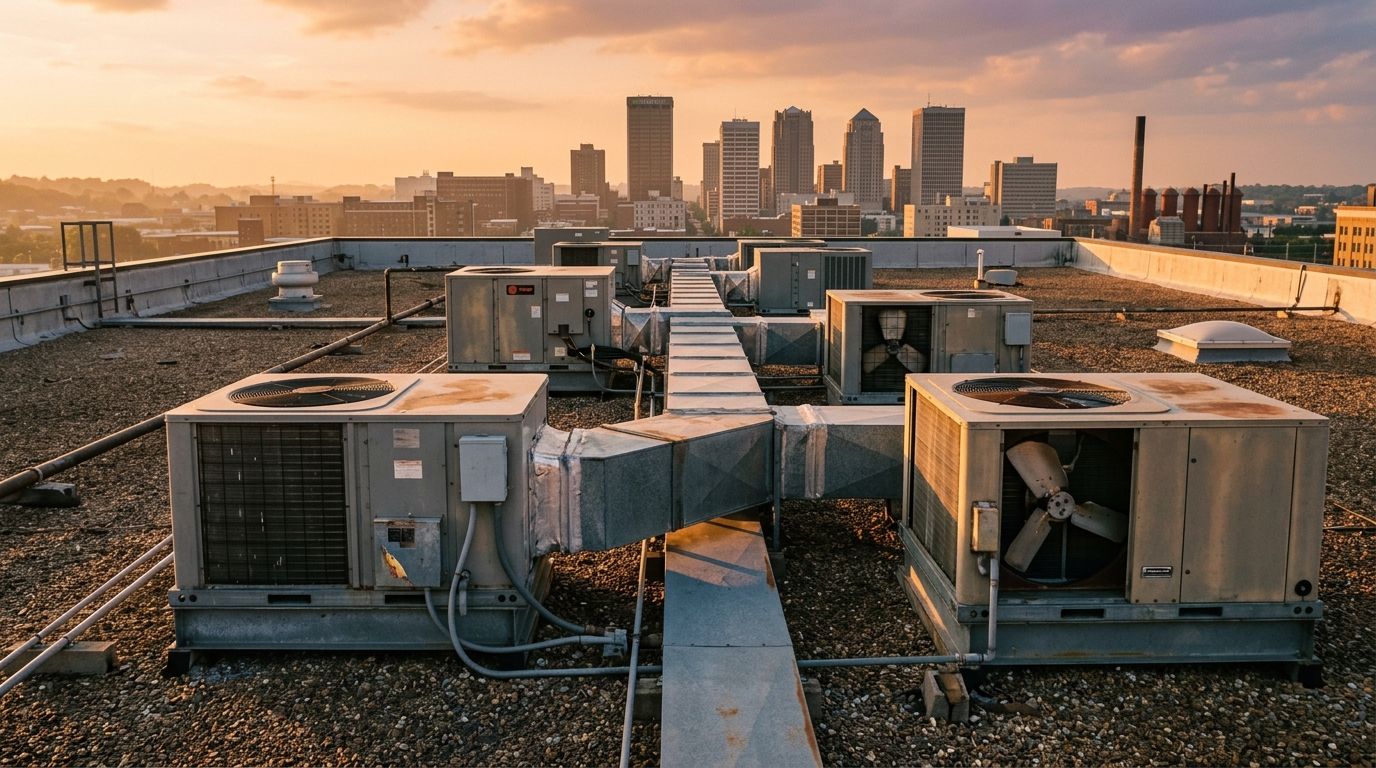
RTU stands for rooftop unit — a packaged commercial HVAC system that lives on the roof of a building rather than in a mechanical room or attic. The defining word is packaged. Inside one curb-mounted enclosure you get the compressor, condenser coil, evaporator coil, supply blower, return-air section, gas heat exchanger or electric heat strips, economizer dampers, controls board, and refrigerant charge. Ductwork drops through the roof curb into the conditioned space below. One unit, one curb, one electrical disconnect, one gas line. The rooftop is the mechanical room [1].
That packaging matters because it is the reason most commercial buildings in Birmingham — strip retail along Highway 280, suburban Class B offices in Inverness and Vestavia, fast-casual restaurants in Lakeview and Cahaba Heights, light industrial along Oxmoor Valley — run RTUs instead of split systems. A residential split system separates the condensing unit (outdoors) from the evaporator coil and air handler (indoors), which is fine for a 1,500 sq ft house but does not scale cleanly to a 12,000 sq ft retail box. Packaged rooftop equipment scales the way commercial buildings scale: you size the unit to the load, drop it on a curb, and run ductwork.
RTU capacity is measured in tons of cooling, where one ton equals 12,000 BTU/hr. Most commercial RTUs in the Birmingham metro fall in the 3 to 25 ton range. Below 5 tons you sometimes see split systems instead. Above 25 tons you start seeing custom or semi-custom rooftop equipment, and above 50 tons you are usually in chiller territory rather than packaged equipment. The 3 to 25 ton band is the sweet spot for Carrier WeatherMaker, Trane Voyager, Lennox Energence, York Sunline, and Daikin Rebel — the dominant commercial RTU platforms on Birmingham buildings [2].
Open the panels of a commercial rooftop unit and you will find five major component groups. The compressor section — usually a scroll compressor on units below 10 tons, sometimes a tandem-scroll or screw configuration above 15 tons — is the mechanical heart of the cooling cycle. The condenser section sits above or beside the compressor, with one or two condenser fans pulling outdoor air across the condenser coil to reject heat. Modern equipment uses ECM (electronically commutated motor) condenser fans that vary speed against load; older units run constant-speed PSC motors that either run full or do not run at all.
The supply blower section moves conditioned air through the duct system. On commercial rooftop units this is typically a forward-curved or backward-inclined centrifugal blower driven by a belt-and-pulley arrangement off a motor mounted alongside, or a direct-drive ECM blower on newer equipment. Belt drive means belts that wear, pulleys that misalign, and bearings that need lubrication on a quarterly preventive maintenance cadence. Direct drive means the bearings live in the motor and you replace the assembly when it fails. The blower compartment also holds the filter rack — typically 2-inch pleated filters on lighter equipment, 4-inch MERV 13 cartridges on properly specified commercial units.
The economizer section is the outdoor-air mixing arrangement that uses cool outside air to meet cooling load when ambient conditions allow it — a meaningful efficiency feature in Birmingham's shoulder seasons (March-April, October-November) when outside temperatures often allow free cooling. The economizer is also where most commercial RTU control problems happen: stuck dampers, failed actuators, dead enthalpy sensors, and miscalibrated changeover setpoints all cost the building energy without anyone noticing. Code-required economizer functionality is part of ASHRAE Standard 90.1 baseline efficiency requirements that Alabama has adopted through the International Mechanical Code [3, 4].
The heat section on commercial RTUs is usually gas-fired (natural gas or LP) with a stainless or aluminized heat exchanger, induced-draft motor, hot-surface ignitor, gas valve, flame sensor, and high-limit and rollout safety switches. Electric heat strips are an alternative on smaller units or buildings without gas service. Gas heat in Alabama means modest heating-season runtime — Birmingham winters are short — but the equipment still needs annual combustion analysis, carbon monoxide testing, and pre-heating-season inspection in the September-October window.
The RTU-versus-split-system decision on Birmingham commercial buildings comes down to building geometry, equipment size, roof access, and tenant configuration. Single-story buildings with accessible flat or low-slope roofs — strip retail, fast-casual restaurants, suburban single-tenant offices, light industrial — favor RTUs almost universally. The roof becomes the mechanical room, ductwork drops through the curb, and the equipment is out of the conditioned space entirely. Service access happens on the roof rather than in a tenant suite, which matters for after-hours dispatch when you do not want to coordinate with tenant building access.
Multi-story buildings with limited roof real estate — downtown high-rises, multi-tenant medical office buildings, mid-rise mixed-use — often run split systems or VRF instead. Putting twenty 5-ton condensing units on a small downtown rooftop creates clutter, weight loading, and refrigerant routing problems that VRF or central chiller plant solutions handle more cleanly. For Birmingham's downtown commercial stock built before 2000, central chiller plant with VAV box distribution is the dominant pattern. For our breakdown of when VRF beats RTU on a mid-rise office, see VRF vs Split Systems for Birmingham Mid-Rise Offices.
Tenant configuration matters for zone count. A single-tenant 12,000 sq ft retail building is a good RTU candidate — one unit, one zone, simple controls. A 12,000 sq ft multi-tenant strip with five tenants of different size means either five separate RTUs (one per tenant, simple but more equipment to maintain) or a single larger RTU with VAV boxes at each tenant (more complex controls but fewer units). The decision usually comes down to tenant turnover assumptions — frequent turnover favors per-tenant equipment because lease changes do not require system reconfiguration; long-term anchor tenants favor consolidated equipment for energy efficiency [5].
Commercial rooftop unit failures cluster in a few predictable categories. Dual-run capacitor failure is probably the single most common cause of an RTU dropping out — the capacitor provides start torque to the compressor and run torque to the condenser fan motor, and capacitors are consumable parts that drift out of their microfarad rating over a 5-7 year life cycle. The classic symptom is a unit that hums when you turn it on but does not start, or a condenser fan that does not spin while the compressor tries to run (which produces a high-pressure trip in 3-5 minutes and a hard-shutdown lockout). Capacitor replacement is a 30-minute job; the failure that triggered the dispatch is preventable on quarterly PM where the technician measures capacitor microfarads against nameplate spec.
Contactor failure is the second-most-common cause. The contactor is the heavy-duty relay that switches line voltage to the compressor and condenser fan when the thermostat calls for cooling. Contactors wear at the contact points — pitting, arc damage, and welded contacts that either chatter or stick closed. Contactor replacement is also a routine quarterly-PM catch when the technician inspects contact condition and electrical resistance. Run-to-failure on a contactor is what produces the Friday-afternoon emergency dispatch [6].
Refrigerant leaks rank third on commercial RTUs. The vibration of compressor operation over years gradually loosens flare connections, fatigues braze joints on coil headers, and produces slow refrigerant losses that show up as creeping cooling capacity decline before they become hard failures. EPA Section 608 leak-rate thresholds apply on systems over 50 lb refrigerant charge — the 20% annual leak-rate threshold for comfort cooling triggers documented repair within 30 days. RTUs in the 10-25 ton range often exceed the 50 lb threshold and fall under the reporting regime [7].
Economizer failures are widespread but underdiagnosed. Dead enthalpy sensors, stuck dampers, broken actuators, and miscalibrated changeover setpoints all cost energy without producing comfort complaints, so they sit broken for years on buildings without disciplined PM. The U.S. Department of Energy has published research showing that 20-40% of commercial RTU economizers in service are not functioning correctly, costing 5-15% of building cooling energy annually [8]. Quarterly PM with documented economizer testing is what catches this.
Heat exchanger cracks on gas-fired RTUs are the fifth category and the most safety-critical. A cracked heat exchanger leaks combustion products including carbon monoxide into the supply airstream. Annual combustion analysis with carbon monoxide testing in the supply air is the inspection that catches this — required by manufacturer service protocol on every commercial gas-fired RTU and a non-negotiable item on heating-season pre-startup PM. Read our commercial RTU lifecycle planning guide for the full year-by-year service interval breakdown.
Commercial RTU controls run from simple to sophisticated. The simplest installation uses a standalone commercial thermostat — often a Honeywell Focus Pro or Pro 8000 series, sometimes a programmable seven-day commercial thermostat — wired directly to the RTU controls board. This works for single-tenant buildings with one or two RTUs and limited need for centralized monitoring. The thermostat handles occupied/unoccupied scheduling, and the building manager handles by-exception attention when something fails [9].
Mid-tier installations integrate RTUs with a building automation system (BAS) — Honeywell WEBs, Tridium Niagara, Siemens Apogee, Johnson Controls Metasys, or Distech are common platforms in the Birmingham commercial market. The BAS provides centralized scheduling across multiple RTUs, alarm management when units lock out or trend abnormal operation, energy reporting against ASHRAE 90.1 baseline expectations, and historical data the property manager uses for capital planning. BAS integration adds installation cost but pays back on multi-RTU buildings through energy management and early-warning fault detection.
The advanced tier adds factory communication protocols (BACnet, LonWorks, Modbus) directly to RTU controls boards, exposing equipment data the building automation system can act on — discharge air temperature, refrigerant pressures (where transducers are factory-equipped), economizer damper position, fan VFD frequency, and fault codes from the unit's onboard controls. Modern Carrier i-Vu, Trane Tracer SC+, Lennox iComfort C, and Daikin Intelligent Equipment platforms all support this. Integration with the BAS at this level enables fault-detection-and-diagnostics (FDD) workflows that catch developing problems before they trigger emergency dispatch [10].
Commercial rooftop unit service cadence on a Birmingham building runs against ASHRAE Standard 180 inspection intervals. Heavy-use buildings with year-round occupied cooling load — restaurants, fast-casual, retail with extended hours, single-tenant offices with consistent operation — get quarterly PM visits covering electrical, refrigerant, mechanical, and controls. Light-use buildings with seasonal or partial-occupancy operation — warehouse offices, light industrial, some retail concepts — can be scoped semi-annually with the visits timed to pre-cooling-season (March-April) and pre-heating-season (September-October) startup windows.
Beyond the scheduled cadence, RTUs need attention when they produce specific symptoms: cooling capacity decline (rooms not reaching setpoint during peak afternoon load), short-cycling (compressor cycling on and off in less than 5-7 minute intervals indicating refrigerant or controls problems), nuisance lockouts (unit locking out and requiring manual reset more than once a month), increased operating sound (bearing failure, belt slip, or refrigerant leak indicators), or visible water leaks at the rooftop or below the supply diffusers (condensate drain blockage or pan corrosion). Any of these is a call-now signal regardless of where the unit sits in the PM schedule [11].
For Birmingham building managers operating multi-RTU portfolios, scoping the service relationship under a written preventive maintenance contract — with explicit equipment inventory, scheduled visit frequency, labor and parts inclusions, and emergency dispatch terms — is materially more efficient than ad-hoc service calls. See our commercial HVAC maintenance contracts guide for the contract structure detail. For year-by-year lifecycle planning past year 10, see the commercial RTU lifecycle planning guide. Or download our RTU Health Audit Template for a self-assessment checklist.
The Birmingham commercial market runs heavily on packaged rooftop equipment. Strip retail along Highway 280 from Inverness through Greystone runs Carrier WeatherMaker, Trane Voyager, and Lennox Energence in the 5-15 ton range. Suburban Class B offices in Vestavia Hills, Hoover, and Mountain Brook run similar equipment, often deferred-maintenance past year 12 and approaching the replacement decision. Fast-casual and quick-service restaurants in Lakeview, Cahaba Heights, and Avondale run RTUs sized for kitchen-heat-load — typically 7.5-15 tons on a unit serving the dining room and bar, with a separate make-up air unit handling the kitchen exhaust replacement.
Light industrial along Oxmoor Valley, Tarrant, and the I-65 corridor runs the largest mix — warehouse buildings with packaged equipment serving office spaces, separate warehouse unit heaters for production-area heating, and process-cooling equipment specific to the manufacturer's requirements. Multi-tenant retail strips and small office parks in suburban Birmingham operate per-tenant RTUs sized to individual leases. Property management firms operating multi-building portfolios consolidate the service relationship under PM contracts that cover all buildings under one vendor.
For owner-operators new to commercial HVAC — restaurant operators on a first build-out, retail concepts opening a Birmingham location, light-industrial companies expanding into a new building — the RTU on the roof is often the single largest mechanical asset on the property. Treating it as a managed asset rather than a run-to-failure utility produces materially better operational outcomes. Quarterly PM with documented service records, lifecycle planning past year 10, and disciplined refrigerant management under EPA Section 608 are the three operational practices that distinguish well-managed Birmingham commercial RTUs from buildings running on borrowed time [12].
Most "the AC is broken" calls from Birmingham restaurants are not AC calls. They are pressure-balance and make…
Retail HVACRetail comfort is not about cold air. It is about how long a customer is willing to stay. Read the entrance pr…
Property ManagementA vetting checklist any Birmingham property manager can run against any commercial HVAC contractor — including…
Commercial HVAC only. Submit the form and a dispatch coordinator follows up by email. For active outages, call (205) 206-6606.
We email confirmation within business hours. For active outages, call the line above.