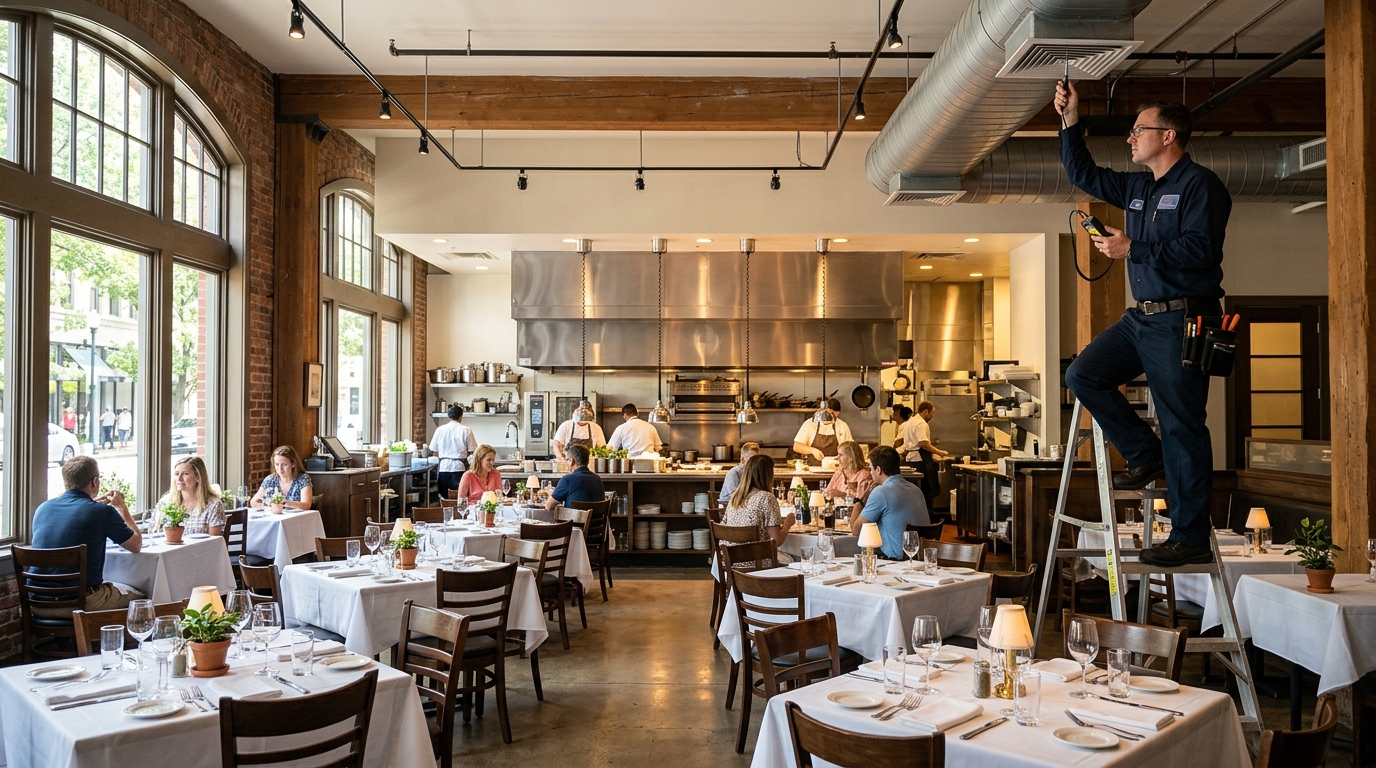
Commercial HVAC · Birmingham, AL
Restaurant Cooling Failures — Why Kitchen Exhaust and Dining Room Balance Decides the Service
Published by the EHRP Commercial Desk. Anonymous field notes from Birmingham, Alabama commercial HVAC dispatch.
Published by the EHRP Commercial Desk. Anonymous field notes from Birmingham, Alabama commercial HVAC dispatch.
Restaurant cooling complaints in Birmingham are usually pressure-balance problems, not undersized AC — when kitchen exhaust hoods move 4,000 to 8,000 CFM out of the building and make-up air is undersized, undamaged, or off, the dining room goes negative, the front door slams against the jamb, the front-of-house air feels still and humid, and the dining-room RTU starts losing the cooling fight even though there is nothing wrong with the compressor.
Eight out of ten "the dining room is too hot" calls from a Birmingham restaurant turn out to have nothing to do with the dining room cooling equipment. The compressor is fine. The refrigerant charge is fine. The condenser coil is clean. The blower is moving the design CFM. And yet the front-of-house is uncomfortable, the host stand keeps the door propped, the bar feels stale, and the GM is calling because customers are mentioning it on the way out [1].
What is actually happening is a pressure-balance failure. The kitchen exhaust hood is pulling 4,000 to 8,000 CFM out of the building every minute it runs at full speed during dinner service. Code-compliant make-up air should be replacing roughly 80 to 90 percent of that volume back into the kitchen and front-of-house combined. When the make-up air unit is undersized for the hood it sits next to, when the dampers are stuck closed because nobody serviced them since the previous franchisee, or when the make-up air unit is switched off at the disconnect because somebody upstream of you found it noisy, the building goes net-negative on air. The cooling system is fighting a building that is now sucking hot Birmingham parking-lot air through every door, window seal, and gap it can find [2].
The tell is at the front door. If you have to lean on the door to push it open against the rush of outside air pulling in, the building is pressure-negative. The dining-room RTU is then trying to cool an air mass that is being constantly replaced with 90-degree outside air. No cooling system on earth will win that fight, and changing the thermostat set-point will not fix it. The fix lives at the kitchen exhaust and the make-up air, not at the dining room.
Commercial kitchen exhaust hood capacity is sized to capture the convective plume coming off the cooking equipment under it — fryers, grills, char-broilers, ranges, salamanders. NFPA 96 sets the fire-safety baseline; the International Mechanical Code adopted in Alabama sets the airflow baseline; manufacturers publish the per-linear-foot CFM requirement for hood type and equipment class [3]. A typical full-service Birmingham restaurant runs somewhere between 2,500 and 8,000 CFM of exhaust depending on hood length and equipment lineup. A pizza place with a single deck oven might be 1,500 CFM. A steakhouse with a wood-fire grill plus a fryer station plus a flat top might be 9,000.
That exhaust volume has to be replaced. Code allows up to roughly 10 to 20 percent of the exhaust volume to be drawn through transfer air from the dining room — air that already entered the building, was conditioned, and is now being pulled through the kitchen on its way out the hood. The remaining 80 to 90 percent has to come from a dedicated make-up air unit, typically a direct-fired or indirect-fired unit on the roof feeding the kitchen ceiling near the hood. The make-up air is tempered — heated in winter, sometimes cooled in summer depending on the system selected — and it is the single largest determinant of whether the building can hold pressure during dinner service [4].
For Birmingham specifically, the summer make-up air load is brutal. You are pulling 4,000 CFM of 92-degree, 75-percent-humidity outside air into the kitchen, and even with a 100-percent outdoor-air conditioning unit on top of it, the cooling load is dominant. Most older Birmingham restaurants were not built with cooled make-up air — they were built with untempered or barely tempered make-up air on the theory that the kitchen is hot anyway. That theory works in March. It fails in July. The kitchen line cooks know it, and so do your customers.
The dining-room rooftop unit was sized — if you are lucky — using ACCA Manual N for commercial small-buildings load calculation, with assumptions about occupancy, lighting, equipment, infiltration, and outside-air requirements per ASHRAE Standard 62.1 [5]. The load calculation almost certainly assumed the building would hold a slight positive pressure or sit at neutral. It did not assume the kitchen exhaust would pull the dining room negative and force the RTU to condition a constant stream of un-tempered outside air leaking in through the front door.
When that happens, the dining-room RTU runs continuously. The discharge air temperature is fine — 55 degrees coming out of the diffuser, which is exactly what it should be. But the return air temperature stays high because the cooling capacity is being consumed by infiltration load rather than the occupied-space load it was sized for. The thermostat in the dining room never satisfies. The unit runs through its design coil-frost limits in humid conditions, and on a really bad night you ice the evaporator coil and trip the unit on freezestat — which then gets dispatched as "AC broke down during dinner service."
The technician shows up. The compressor is fine. The charge is fine. The coil thaws out and the unit restarts. The technician documents normal operation. The GM is frustrated because the unit clearly is not working but the tech says it is fine. The vicious cycle is built on a missed diagnosis — the dining-room RTU is not the failure. The kitchen exhaust and make-up air balance is the failure, and the dining-room RTU is just the loudest symptom.
Five things a Birmingham restaurant operator or GM can verify before calling commercial HVAC dispatch. None require tools beyond a notepad and your phone. First, walk to the front door during dinner service. Open it. Does outside air rush in, or does the door swing easily? If outside air is rushing in, the building is pressure-negative, and the problem is upstream of the dining-room RTU. Second, walk into the kitchen and look at the make-up air diffusers above the hood line. Are they actually blowing air down? If you cannot feel air movement from them during service, the make-up air unit is off or the dampers are closed [6].
Third, check the make-up air unit's electrical disconnect on the roof or in the mechanical space. Is it switched on? You would be amazed how often a previous tech, an electrician, or a curious manager flipped the disconnect off and nobody noticed because the kitchen exhaust kept running and the dining room kept "mostly working" until peak service. Fourth, look at the kitchen exhaust hood. Is the hood operating at full speed during service, or has the variable-frequency drive been turned down to reduce noise complaints, which reduces both exhaust and the required make-up air response if the system is interlocked? Fifth, ask the line cooks if the dining room ever felt better. The line cooks always know. If they say "yeah, it used to be better before they redid the bar last spring," you have an answer.
Document what you find before you call. A photo of the front door swinging open under pressure, a note that the make-up air diffusers are still, and the make-up air unit serial number from the rooftop nameplate gives the dispatched technician a 15-minute head start on diagnosis. That is real money on a Friday night dispatch.
A commercial technician arriving on a pressure-balance call works the system as a system, not the equipment as isolated boxes. Step one is verifying the kitchen exhaust hood airflow against the manufacturer rating and the original commissioning report if one exists. A pitot tube or hot-wire anemometer in the exhaust duct gives a real CFM reading. Step two is verifying the make-up air unit airflow with the same instrumentation in the supply duct or at the diffusers, depending on access. The two numbers should be in the 80-to-90-percent ratio described above. If they are not, that is the headline finding [7].
Step three is verifying damper position, interlock function, and control logic. Some kitchen exhaust and make-up air systems are interlocked — the make-up air ramps up when the exhaust hood ramps up. Some are not, and the make-up air just runs continuously during occupied hours. Either configuration can fail. The technician checks the actual response of the make-up air to a hood-speed change, confirms damper position visually, and verifies the control wiring against the system schematic.
Step four is verifying the dining-room RTU is not also broken. Two failures can coexist. If the RTU is running correctly on a building that has been pressure-negative for two summers, the technician documents normal operation but flags the infiltration load as a likely chronic issue that may have shortened compressor service life. If the RTU is running incorrectly — short-cycling, low charge, dirty coil — that gets a separate work order. Both issues get written up; the building owner gets the full picture rather than a partial fix.
If the diagnosis is "make-up air unit is undersized for the kitchen exhaust hood," the fix path runs from cheapest to most expensive. Cheapest first: verify the make-up air unit is actually delivering its rated CFM. Cleaned filters, cleaned coil, belt tension, fan-wheel inspection, damper actuator function — all of these can degrade airflow over time. Restoring rated airflow on an existing unit costs a single service visit and might solve the problem. Next: rebalance the system. If the make-up air is delivering correctly but the diffuser layout is wrong, redirecting airflow to the right kitchen zones may rebalance the pressure without new equipment [8].
Next tier: replace the make-up air unit with a properly sized direct-fired or indirect-fired commercial unit. This is a planned capital project, not a same-day dispatch, but on most Birmingham restaurants the existing make-up air unit is 15 to 25 years old and is at end-of-life anyway. Sizing the replacement against the actual kitchen exhaust hood capacity — not against the spec on the building blueprint from 1998 — is the critical engineering step. Most older Birmingham restaurants have had their kitchen equipment changed multiple times; the hood may now be sized for equipment that was not in the original load calculation.
Final tier on really problematic buildings: redesign the exhaust hood and make-up air as a coordinated system. If a restaurant has expanded the kitchen, added a wood-fire grill, or added a fryer station that pushed the exhaust requirement past what the original hood and make-up air can support, the answer is a coordinated equipment upgrade. That is a contractor-plus-architect-plus-mechanical-engineer project. We will scope it honestly and tell you when the scope crosses that line, rather than selling you an undersized make-up air replacement that fails the same way in three years.
Three patterns repeat across the Birmingham metro restaurant work. The first is the converted-space restaurant — a building that was retail or office and was renovated into a restaurant 5 to 15 years ago. These buildings almost always have undersized make-up air because the original HVAC was designed for a different occupancy class. The dining room cooling was upsized during the conversion; the make-up air often was not. The pressure-balance failure shows up the first hot July and never gets fully diagnosed.
The second is the multi-generation restaurant — a building that has been a restaurant for decades but has had three or four operators, each of whom changed the kitchen equipment without touching the hood-and-make-up-air-as-a-system. The exhaust requirement crept up; the make-up air stayed the same. The current operator inherits the cooling complaint and assumes it is an AC problem because that is the symptom they are seeing.
The third is the franchised or chain restaurant operating in a building the franchisee did not build. The franchise build standard assumes certain things about the building; the actual building may not match. The dining room cools fine in the test market but loses the fight in a Birmingham summer because the franchise build sheet did not specify enough make-up air for our climate. A property management firm or single-store operator running into this can document the issue against the corporate build sheet and often get capital relief from the franchisor rather than absorbing it locally.
In all three patterns, the fix is not a bigger dining-room AC. The fix is honest scoping of the kitchen exhaust and make-up air as a system that drives the rest of the building's pressure. Read our maintenance-contract scoping guide for the PM language that catches make-up air drift before it becomes a summer crisis, and our walk-in cooler troubleshooting checklist for the back-of-house companion issue.
Retail comfort is not about cold air. It is about how long a customer is willing to stay. Read the entrance pr…
Walk-In Cooler TroubleshootingA field-tested checklist for restaurant and grocery operators when the walk-in cooler temperature climbs above…
Restaurant RefrigerationCompressor monitoring, evaporator service, TXV inspection, refrigerant compliance, and pre-service protocols t…
Commercial HVAC only. Submit the form and a dispatch coordinator follows up by email. For active outages, call (205) 206-6606.
We email confirmation within business hours. For active outages, call the line above.