Commercial HVAC · Birmingham, AL
Retail Comfort — Entrance Loads and the Customer Dwell-Time Equation
Published by the EHRP Commercial Desk. Anonymous field notes from Birmingham, Alabama commercial HVAC dispatch.
Published by the EHRP Commercial Desk. Anonymous field notes from Birmingham, Alabama commercial HVAC dispatch.
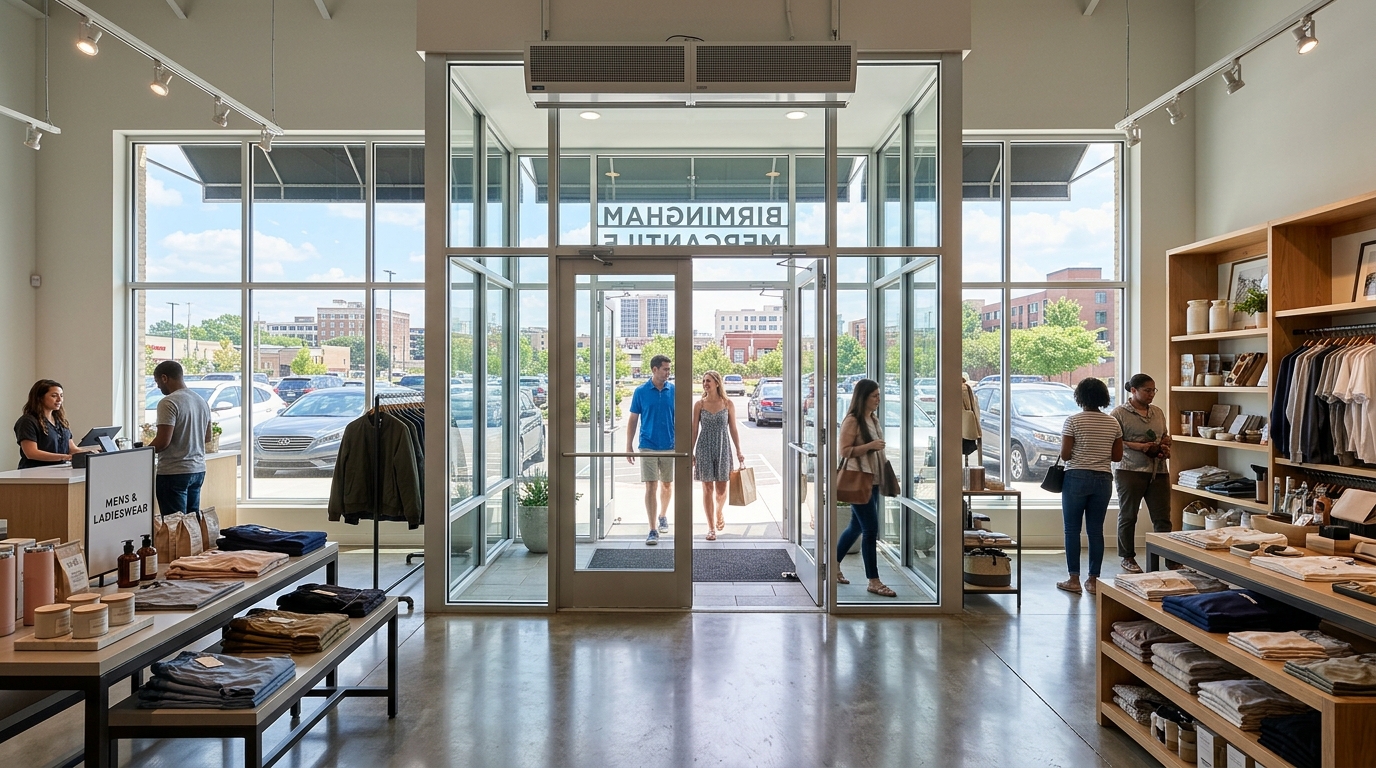
Retail dwell time is materially affected by entrance air-handling design — a poorly performing front-of-store air curtain or a vestibule running at the wrong pressure pulls hot Birmingham parking-lot air into the first 20 feet of selling floor, creates a damp-feeling humidity layer at customer eye level, and shortens average dwell time by minutes per visit — and minutes per visit drives basket size, conversion, and the comp-store numbers retail GMs actually report on.
Retail comfort engineering is one of the most under-discussed disciplines in commercial HVAC because the people running stores rarely talk to the people running the HVAC contracts and the people running the HVAC contracts rarely think in retail terms. The number that links them is customer dwell time. Comp store sales, basket size, conversion rate, and average transaction value are all materially correlated with how long a customer stays inside the store, and how long a customer stays inside the store is materially correlated with how the store feels at the front 20 feet [1].
Retail brands with strong category benchmarking know this. Apparel stores measure dwell. Bookstores measure dwell. Grocery measures dwell. The HVAC contribution to dwell shows up indirectly in the customer-experience metrics retail GMs already report on. A dollar of conversion-rate improvement at a 200,000-customer-per-year store is real money, and even a small dwell-time improvement compounds across that traffic count.
For property managers running Birmingham retail centers and mall properties, the dwell-time logic also applies to common areas. Mall corridors, food court seating, and anchor-tenant transitions all have their own dwell economics. Common-area comfort engineering is part of the leasing case to tenants, not just an operating expense [2].
Every time a retail entrance door opens, two things happen. Conditioned air escapes outward, and outside air rushes inward. The exchange volume per door cycle depends on door size, outdoor wind, indoor-versus-outdoor temperature differential, and the pressure differential across the doorway. On a hot Birmingham summer afternoon with a 25-degree differential between 92 outside and 67 inside, a single double-door cycle can exchange 150 to 400 cubic feet of air per opening event [3].
Multiply that by a busy entrance — 30 to 60 door cycles per hour during peak retail traffic — and the entrance air-handling load alone can run thousands of CFM of infiltration that the front-of-store cooling equipment must absorb. Two engineering responses exist: air curtains across the doorway opening, which create a moving air barrier reducing the exchange volume per opening event, and entrance vestibules with an inner and outer door, which trap the air exchange in a buffer space before it reaches the selling floor.
Both responses can fail in predictable ways. Air curtains lose performance as the fan motor ages, when the discharge nozzle is misaligned, or when the unit was undersized for the doorway opening in the first place. Vestibules lose performance when both doors are propped open during high-traffic periods, when the vestibule HVAC is undersized for the buffer-space requirement, or when the inner-door sealing fails. The "front of the store always feels warm" complaint is usually one of these failures, not a central cooling failure [4].
Birmingham outdoor summer humidity averages 70 to 80 percent. When entrance infiltration brings that humidity into the first 20 feet of store, the local indoor humidity climbs noticeably above the rest of the store. Customers do not consciously read a humidity number, but they feel it as "stale" or "muggy" or "the air feels heavy here." That perception happens at customer eye level, where the air curtain or vestibule failure is most visible in the moisture content of the air [5].
Properly designed retail HVAC includes dehumidification capability — either through the cooling coil with enhanced latent capacity, or through a dedicated dehumidification system on the make-up air. Older Birmingham retail buildings often skipped this step because the original design treated humidity as a free byproduct of cooling. Modern retail design treats humidity as an independent variable with its own equipment scope, and the comfort difference at the entrance is dramatic.
For property managers and retail GMs running older buildings, the first move on a chronic front-of-store comfort complaint is measuring the actual relative humidity at customer eye level in the first 20 feet versus the back of the store. A 10-to-15-percent RH differential between front and back is a clear signal that entrance infiltration is overloading the local cooling capacity, and the fix lives at the entrance equipment, not the central system.
Commercial air curtains create a high-velocity air stream across the doorway opening that reduces the air exchange when the door is open. Selection matters: the air curtain must be sized for the door width, mounted at the correct height, angled correctly relative to the floor, and rated for the temperature differential the building experiences. Undersized or misapplied air curtains do little to reduce infiltration and may actually make the customer-eye-level comfort worse by creating drafts [6].
Properly applied air curtains achieve 60 to 80 percent reduction in air exchange across the doorway. That is meaningful: a doorway moving 4,000 CFM of infiltration per hour during peak traffic drops to 800 to 1,600 CFM with a working air curtain. The cooling-load reduction at the entrance translates directly to better front-of-store comfort, lower humidity in the first 20 feet, and reduced load on the front-of-store cooling equipment.
Maintenance matters. Air curtain motors are continuous-duty during operating hours. Motor bearings, fan blade balance, discharge nozzle alignment, and filter condition all affect performance. A quarterly inspection routine that verifies discharge velocity, motor amperage, and bearing condition catches degradation before it becomes a customer-comfort complaint. Most retail building maintenance contracts under-scope air curtain service because the unit is not glamorous; that is exactly why it gets neglected.
Entrance vestibules are the other engineering response to the entrance load problem. A properly designed vestibule includes an outer door, a buffer space sized for at least one person to clear before opening the inner door, and an inner door. The vestibule space itself is conditioned to roughly the building setpoint, and the air exchange across each door is much smaller because the buffer space limits how much outside air actually reaches the selling floor.
Vestibules fail when both doors are propped open during high-traffic periods (common during sale events and busy weekends), when the vestibule HVAC is undersized for the buffer-space load and cannot maintain the setpoint, or when the inner-door sealing degrades and the buffer effect is lost. The propped-door failure is the most common and the least technical — it usually comes down to traffic flow during peak times and the door-closer mechanism not having the strength to fight customer flow.
Solutions: invest in stronger door closers, train front-of-store associates to redirect propped doors during peak periods, upgrade the vestibule HVAC if it cannot maintain its setpoint under summer load, and verify the inner-door seal condition annually. None of these are expensive interventions; all of them produce noticeable comfort improvement at customer eye level.
Most Birmingham retail outside the major malls runs on packaged rooftop units serving individual tenant spaces in strip centers and outparcels. The typical configuration is a 5-to-15-ton RTU per tenant space, with shared outside-air ducting on some properties and independent outside-air on others. The strip-center landlord typically owns the RTU; the tenant typically operates it. This creates a coordination problem because the tenant feels the comfort complaint and the landlord controls the equipment [7].
For property managers running strip-center portfolios, the entrance-load problem appears differently across tenants. A clothing retailer with a single front entrance and 30-foot store depth has a fundamentally different load profile than a fast-casual restaurant with the same square footage but a kitchen exhaust hood pulling 3,000 CFM out of the back. Both call the property manager when comfort fails. The right diagnostic conversation distinguishes the two failure modes rather than treating both as "the AC is broken" complaints. Our restaurant pressure-balance guide covers the restaurant case in detail.
The strip-center RTU sizing question also deserves attention. Many Birmingham strip centers were built in the 1980s and 1990s with HVAC sized for the tenant mix at the time. Twenty-five years later, the tenant mix has rotated multiple times, and the current tenants may have different load profiles than the original design assumed. A property manager scoping a chronic comfort complaint at one tenant should ask whether the load assumptions still match the current use; a tenant build-out that increased glazing, added cooking equipment, or changed occupancy density may have moved the load past what the original RTU can handle.
Birmingham's larger retail properties — Riverchase Galleria, the Summit, and the smaller indoor mall properties — operate on central chiller plants for common areas with individual tenant cooling for inline shops. The common-area comfort is the property's responsibility; the tenant comfort is the tenant's responsibility under the lease. Both affect the customer experience, and both need to work for the retail center to perform.
Common-area comfort engineering in malls focuses on the long sight lines, the entrance vestibules at each anchor, and the food court area where customers are seated for extended periods. Anchor entrance vestibules have the same physics as standalone retail entrances but at larger scale — the door openings are larger, the traffic count is higher, and the comfort impact is proportionally bigger. Air curtain or oversized vestibule design at the anchor entrances is a meaningful capital investment but produces lasting comfort improvement.
Food court HVAC has its own challenges because of cooking exhaust from the food vendor stalls (similar to restaurant pressure-balance concerns), combined with high occupancy density during meal periods. The cooling load varies dramatically with time of day, and the make-up air requirement for the food vendor exhaust drives the system design. Common-area engineering for food courts deserves dedicated scoping rather than treating it as an extension of the mall corridor HVAC.
For retail GMs running individual stores: track front-of-store comfort complaints by time of day and weather conditions. Correlate against entrance traffic count if you have door-counter data. Note when comfort complaints spike (peak traffic days, hot weather, after holiday weekends with high door usage) and document the conditions for the landlord or HVAC contractor. The pattern data converts a vague comfort complaint into a diagnosable issue.
For property managers running multi-tenant retail: track tenant comfort complaints by tenant type and entrance configuration. Tenants with no vestibule and high door traffic will complain more than tenants with vestibules; that is a building issue, not a tenant issue. Allocate maintenance dollars to the entrance equipment (air curtains, vestibule HVAC, door closers) as part of the property operating budget rather than waiting for tenant complaints to escalate.
For both groups, the connection back to revenue is the dwell-time and comfort-perception equation. A retail space where customers stop browsing because the front feels stale is leaving money on the table. The HVAC fix is rarely a central equipment replacement; it is usually entrance-zone discipline applied consistently over time. Read our maintenance-contract scoping guide for the PM language that catches entrance-equipment drift before it becomes a tenant retention conversation.
Most "the AC is broken" calls from Birmingham restaurants are not AC calls. They are pressure-balance and make…
Walk-In Cooler TroubleshootingA field-tested checklist for restaurant and grocery operators when the walk-in cooler temperature climbs above…
Restaurant RefrigerationCompressor monitoring, evaporator service, TXV inspection, refrigerant compliance, and pre-service protocols t…
Commercial HVAC only. Submit the form and a dispatch coordinator follows up by email. For active outages, call (205) 206-6606.
We email confirmation within business hours. For active outages, call the line above.