Commercial HVAC · Birmingham, AL
Office Building HVAC — Comfort Complaints Decoded by Zone
Published by the EHRP Commercial Desk. Anonymous field notes from Birmingham, Alabama commercial HVAC dispatch.
Published by the EHRP Commercial Desk. Anonymous field notes from Birmingham, Alabama commercial HVAC dispatch.
Office building comfort complaints in Birmingham almost always cluster by zone — perimeter offices on the west and south faces complain about heat from 2 PM to 6 PM in summer, interior conference rooms complain about cold and stuffiness all year, corner offices complain about both depending on time of day, and the pattern of who is complaining at what time tells the building engineer or facilities manager which VAV box, which RTU, or which thermostat is actually the failure point.
Most office building managers receive comfort complaints as if they were random noise — a thermostat war between two tenants, an HR forwarded email, a maintenance ticket with no detail. Treated as noise, complaints repeat forever. Treated as data, they map directly onto the building's zoning and reveal which specific piece of equipment is actually failing. The same five complaints in five different rooms is rarely five separate problems; it is usually one zoning failure manifesting in five symptoms [1].
The first move on any chronic-complaint floor is mapping the complaints to the floor plan. Where is the thermostat? Which VAV box serves which rooms? Which compass direction does each window face? Where do the diffusers actually discharge? Where does the return air actually return? Five minutes with the as-built drawings — or a tape measure and a notepad if no drawings exist — converts the comfort complaints from random noise into a diagnostic pattern. The pattern tells you whether the failure is at the equipment level, the controls level, or the design level [2].
For property managers running portfolios across the Birmingham metro, the same diagnostic discipline applied across multiple buildings starts to reveal building-level patterns rather than tenant-level patterns. A building where the perimeter offices on the west face complain every summer is a building with a chronic afternoon load issue that no amount of thermostat adjustment will fix. The conversation moves from tenant relations to capital planning, and that is the right place for it to be.
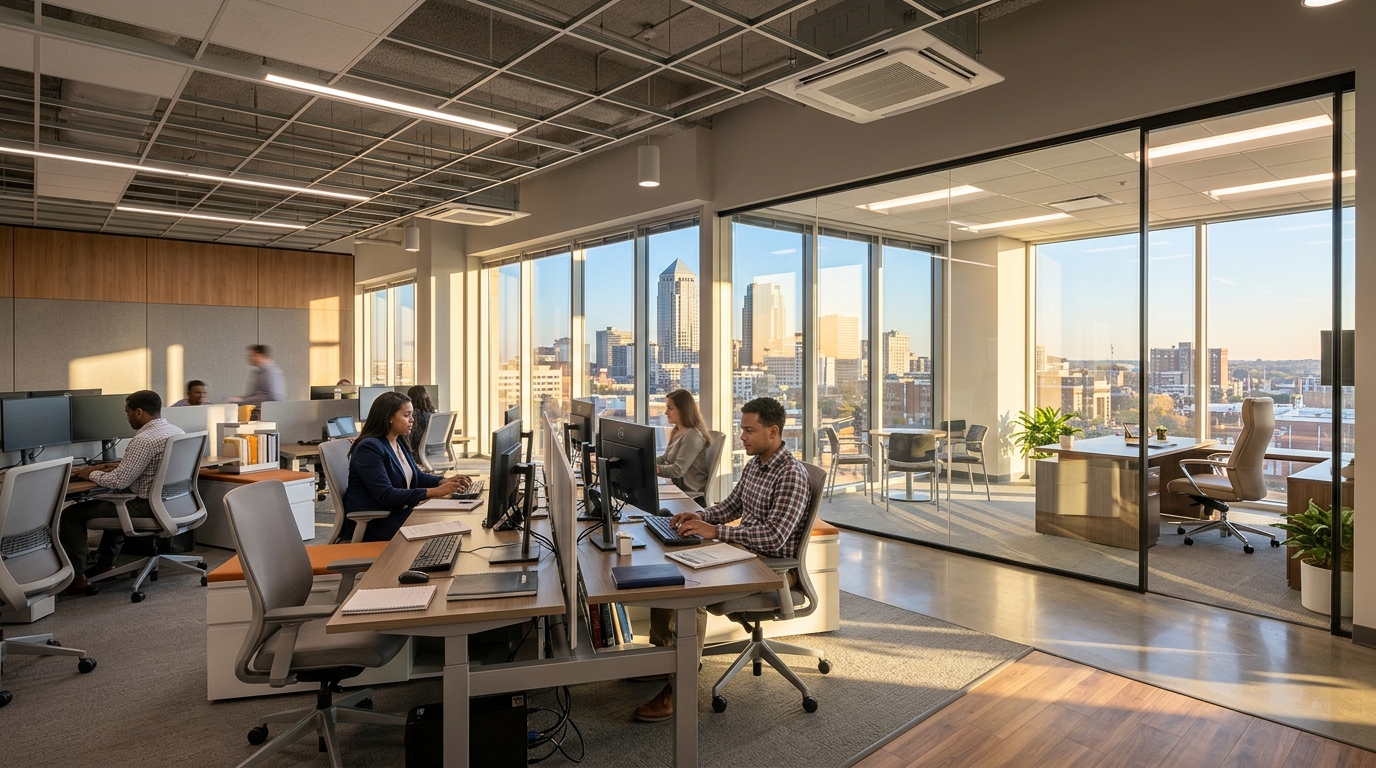
Office building HVAC is almost always zoned along two primary axes: perimeter versus interior, and compass orientation within the perimeter. Perimeter zones — offices and conference rooms along the exterior wall — experience solar load through windows, conduction load through walls, and infiltration load through window frames and door seals. Interior zones — the core conference rooms, copy rooms, and cubicle farms with no exterior wall — experience essentially zero solar or conduction load; their entire cooling demand comes from people, lights, and equipment heat [3].
This creates a basic but persistent mismatch in any office building. In summer, the perimeter is overloaded with solar gain on the sunny faces while the interior runs steady on people-and-equipment load. In winter, the perimeter zones lose heat through windows and walls while the interior zones still need cooling because the people-and-equipment load is unchanged. Properly designed buildings use separate perimeter and interior VAV boxes, separate reheat coils on the perimeter for the winter problem, and zoning logic that handles the perimeter-versus-interior conflict. Improperly designed or poorly maintained buildings let the conflict play out as comfort complaints [4].
Reading the complaint pattern: perimeter offices complain about heat in the afternoon mean the perimeter VAV is undersized, the reheat is overactive (heating against cooling), or the perimeter zone is sharing a thermostat with an interior zone. Interior conference rooms complain about cold and stuffiness means the people-load and ventilation-load are not being addressed correctly — likely the VAV is reaching minimum airflow set-point and starving the room of fresh air while the cooling load is still high.
If you are managing an office building in Birmingham, you already know the west face is the problem face. Solar load on the west side of a building in Birmingham peaks between 2 PM and 6 PM in summer, exactly when the building is fully occupied, people are running computers and meetings, and the chiller plant or rooftop equipment is already at maximum load from the morning ramp. The west-facing offices feel the heat, complain the loudest, and prove that no amount of thermostat adjustment will fix a fundamental solar-gain mismatch [5].
The west face load matters because the design assumption almost always assumed shaded conditions, low-E glazing performance at end-of-life rather than new, and HVAC equipment running at rated capacity rather than degraded. By year 15 or 20, the windows have lost some thermal performance, the building automation may not be sequencing the perimeter zones optimally, and the original VAV box terminals may be running on degraded actuator response. The west-face complaint pattern is the building telling you the original design margin has been eaten.
What works on a chronic west-face complaint pattern: separate VAV box and thermostat for the west-facing offices so they run independently of east-facing offices; verify the perimeter reheat is sequenced correctly with cooling (if the reheat is overactive against cooling, the building is fighting itself); inspect and rebalance the airflow to confirm each west-facing diffuser is delivering rated CFM; verify the actual solar load against the as-built calculation, with attention to whether tenant build-outs may have added unexpected interior loads on the same zone. None of these fixes require new central equipment, but all of them require diagnostic discipline rather than thermostat-fiddling.
Interior conference rooms generate one of the most frustrating complaint patterns in office HVAC: they are simultaneously too cold and too stuffy, and adjusting the thermostat one way makes the other complaint worse. This is a real engineering problem, not user error. The room has minimal building-shell load but high transient load from people, laptops, and projectors. When a meeting starts, the room load spikes; when the meeting ends, it drops to nearly zero. The VAV box serving the room cycles between maximum airflow during occupied meetings and minimum airflow during empty periods [6].
Two failure modes typical here. First, the VAV minimum airflow is set too low for the room ventilation requirement under ASHRAE Standard 62.1. A conference room sized for 12 occupants needs a minimum CFM that delivers code-required outside air. When the box throttles back to its minimum during low-occupancy periods, the CO2 may climb past ASHRAE comfort thresholds, the room feels stuffy, and the next occupant who walks in calls it "musty" [7]. Second, demand-controlled ventilation may not be installed or may not be configured. A properly DCV-equipped conference room reads CO2 in real time and modulates outside air against occupancy. Without DCV, the room is either over-ventilated when empty (wasting energy and cooling) or under-ventilated when full (the complaint pattern).
The fix lives at the controls and the VAV box settings, not at the central RTU or chiller. Building automation system review against the room's actual occupancy profile, VAV box minimum-airflow re-setting against current 62.1 requirements, and DCV installation where the room load profile justifies it. These are facility-management-level conversations between the property manager, the tenant, and the controls vendor. Done correctly, they make a previously-impossible room into a normal one.
Corner offices are the classic single-thermostat-controlling-two-zones problem. A corner office has two exterior walls facing two different compass orientations, each with its own solar profile, each generating its own time-of-day load. One thermostat in the room cannot satisfy both walls simultaneously. The complaint is variable: morning the office feels fine, late-morning the south wall is hot, mid-afternoon the south is cooling and the west is heating, evening the room rebalances. The occupant feels like the HVAC is "doing something weird" because in fact it is.
Solving the corner-office problem properly requires either a redesign with two VAV boxes serving the room (one per orientation) or accepting the comfort variability and managing occupant expectations. Most properly engineered Class A office buildings include this from the original design. Older Class B office buildings often did not. Property managers inheriting a Class B building with chronic corner-office complaints face the choice of capital project (separate zoning) or operational workaround (window film to reduce solar gain, automated blinds, occupant relocation).
One worthwhile diagnostic before any capital project: verify the existing VAV box is actually performing to spec. Stuck dampers, failed actuators, and miscalibrated controls produce corner-office complaint patterns that look like design problems but are actually maintenance problems. A 30-minute VAV box inspection during off-hours can sort design issues from equipment issues.
The single largest mental shift for an office building manager dealing with chronic comfort complaints is moving from "fix the thermostat" to "read the floor as a system." A floor is a coupled mechanical system: the air handler delivers conditioned air at a constant temperature; the VAV boxes modulate airflow to each zone; the thermostats sense zone temperature and signal the VAV; the building automation system coordinates the whole assembly against outside conditions; the reheat coils on perimeter zones handle the winter problem; the return air path completes the loop. A complaint in one room is a signal from one node in the system [8].
Reading the floor as a system means: pulling the building automation system trend data for the affected zones (most office BAS retain a week or month of trend data; the property manager just has to ask for it); mapping complaints to specific VAV boxes against the as-built drawings; walking the floor during the complaint window to feel diffusers, return grilles, and zone temperatures directly; correlating outside conditions to complaint timing (afternoon-only complaints suggest solar load, time-of-week complaints suggest occupancy patterns, anytime complaints suggest equipment failure). The diagnostic discipline takes hours, not days, and reveals root causes that thermostat adjustments cannot reach.
For Birmingham specifically, the BAS trend correlation is a tool most managers do not use. Birmingham summers run for six months. A summer of trend data on a problem floor reveals which zones consistently run at maximum cooling demand, which zones constantly fight reheat against cooling, which zones never reach their setpoint during peak afternoon load. That data drives the capital plan and the maintenance plan in ways the complaint log alone cannot.
Some complaint patterns escalate from "fix the VAV box" to "rethink the system." Indicators that a floor or building has crossed the line: complaints across multiple zones on multiple orientations simultaneously suggest the central air-handling capacity or chilled-water supply is insufficient at peak; complaints that worsen year-over-year despite ongoing maintenance suggest equipment is approaching end-of-life; complaints that correlate with specific tenant build-outs suggest the build-out exceeded the design assumptions for the floor (typical example: a tenant converts open cubicle space to dense private offices, dramatically increasing perimeter zone count without upgrading the perimeter HVAC).
At that point the conversation moves from facility management to capital planning. A building condition assessment, a current load calculation against actual tenant build-out, and a refrigerant compliance review (under EPA AIM Act phase-down for older equipment) gives the asset manager the data needed to scope the right project — equipment replacement, controls upgrade, zoning redesign, or some combination. For multi-building portfolios, the same diagnostic applied across the portfolio reveals which buildings warrant capital and which can run on disciplined maintenance for another five to ten years.
For day-to-day operations, the best practical advice we can give Birmingham office building managers is: track the complaints by zone with timestamps, pull the BAS trend data quarterly even when there is no acute problem, and use the maintenance contract to schedule diagnostic discipline rather than purely reactive service. Our maintenance-contract scoping guide covers the PM language that builds diagnostic discipline into the recurring service rather than treating every visit as an isolated event.
A vetting checklist any Birmingham property manager can run against any commercial HVAC contractor — including…
Light IndustrialWarehouses are not one big room. They are zones — and the zones that matter for your operation depend on wheth…
Medical Office HVACMedical office HVAC has a tighter humidity target than a general office and an honest reason for it. Read what…
Commercial HVAC only. Submit the form and a dispatch coordinator follows up by email. For active outages, call (205) 206-6606.
We email confirmation within business hours. For active outages, call the line above.