Commercial HVAC · Birmingham, AL
Medical Office Humidity — Why 30 to 50 Percent Relative Humidity Matters for Patients
Published by the EHRP Commercial Desk. Anonymous field notes from Birmingham, Alabama commercial HVAC dispatch.
Published by the EHRP Commercial Desk. Anonymous field notes from Birmingham, Alabama commercial HVAC dispatch.
Medical office buildings in Birmingham should hold indoor relative humidity in the 30-to-50-percent band per ASHRAE Standard 170 and FGI Guidelines for Design and Construction of Outpatient Facilities — that band reduces airborne pathogen viability, supports patient mucosal comfort, and protects sensitive equipment, but hitting the band reliably in an Alabama climate with 70+ percent outdoor summer humidity requires correctly sized cooling equipment with dehumidification capability, separate humidity control on the make-up air, and disciplined monitoring rather than ambient room set-points alone.
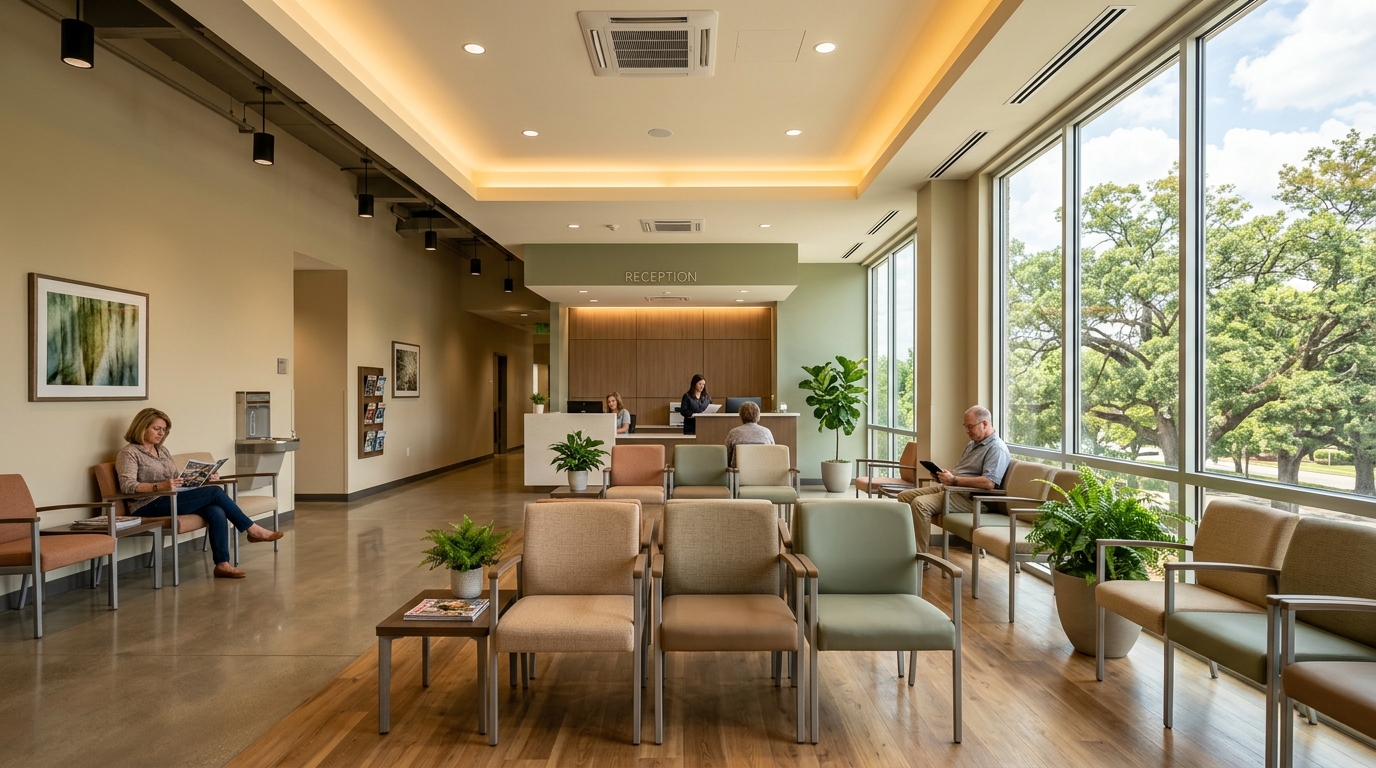
Medical office buildings have a tighter humidity tolerance than general commercial office space because indoor relative humidity directly affects patient outcomes, infection control, and the function of sensitive medical equipment. The recommended band is 30 to 50 percent relative humidity, with most guidance documents specifying tighter tolerances for specific medical uses [1]. This is not a marketing band; it is grounded in clinical research on airborne pathogen viability, mucosal comfort, and equipment performance.
The clinical reasoning runs in three directions. Below 30 percent RH, the airborne particles that carry respiratory pathogens stay aerosolized longer because evaporation reduces their mass and increases their travel distance; patient mucous membranes dry out, reducing the body's natural pathogen barrier; and static electricity discharge becomes a concern around sensitive electronic equipment. Above 50 percent RH, microbial growth (mold, bacteria, dust mites) accelerates in interior surfaces and HVAC equipment; condensation risk on cold surfaces increases; and patient thermal comfort suffers because higher humidity reduces evaporative cooling from skin [2].
The 30-to-50 band represents the convergence of these constraints. It is the band where airborne pathogen viability is reduced versus low humidity, microbial growth is suppressed versus high humidity, patient comfort is acceptable, and equipment performance is preserved. ASHRAE Standard 170, the FGI Guidelines for Design and Construction of Hospital and Outpatient Facilities, and CDC environmental guidelines for healthcare facilities all converge on similar humidity targets [3].
ASHRAE Standard 170 Ventilation of Healthcare Facilities is the primary industry standard for healthcare HVAC design. It specifies ventilation rates, pressurization relationships, filtration requirements, and humidity targets by space type. For most outpatient medical office spaces, ASHRAE 170 specifies a maximum 60 percent RH design value with operational targets in the 30-to-50 band. Specific spaces — operating rooms, procedure rooms, sterile compounding areas — have tighter tolerances and more aggressive monitoring requirements [4].
The FGI Guidelines for Design and Construction of Outpatient Facilities is the companion document for outpatient medical office construction and renovation. FGI references ASHRAE 170 for HVAC engineering, adds construction and equipment-specific guidance, and is referenced by many state health department codes for medical office permitting. Birmingham medical office construction typically follows FGI guidelines through the Alabama Department of Public Health permitting process for licensed medical facilities.
For property managers operating medical office buildings (MOBs) — single-tenant doctor's offices, multi-tenant medical buildings, dental offices, urgent care facilities, ambulatory surgery centers — the FGI baseline is the design floor. Older MOBs predating modern guidance may not meet current standards; renovation triggers the FGI requirements; new construction must comply. The humidity target lives in this framework.
Birmingham's outdoor summer humidity routinely runs 70 to 80 percent during the June-to-September peak season. Outdoor design conditions for HVAC engineering in Birmingham are typically 92 to 95 degrees Fahrenheit with 75 to 78 percent relative humidity at the 1-percent design hour. That is high humidity by national standards, comparable to Gulf Coast cities and meaningfully higher than mid-Atlantic or Midwest cities of similar latitude [5].
For medical office HVAC, this means the cooling equipment must remove substantial moisture from the air to bring indoor RH into the 30-to-50 band. Sensible cooling alone (lowering air temperature) does not get you to humidity target; you need latent cooling capacity (removing moisture). Equipment selection matters: standard commercial RTUs at peak Birmingham summer conditions may struggle to maintain indoor RH below 55 percent if the latent capacity was not specified at design.
The typical failure mode in older Birmingham medical office buildings is exactly this — equipment that maintains temperature setpoint but allows humidity to drift above 55 percent during summer afternoons. Patient and staff comfort suffers; mold growth risk increases in HVAC equipment and interior surfaces; sensitive equipment shows occasional condensation on cold metal surfaces. The fix lives at the equipment specification, not at the thermostat.
Three equipment strategies handle the Birmingham humidity challenge for medical office spaces. Strategy one: cooling equipment specified with enhanced latent capacity. Commercial RTUs are available in standard, intermediate, and high-latent configurations. High-latent units run the cooling coil colder, dehumidify more aggressively, and may include hot-gas reheat to control supply air temperature without reducing dehumidification. This is the most common solution for new MOB construction and retrofit [6].
Strategy two: dedicated outdoor-air systems with dehumidification. A DOAS unit handles outside air separately from the main cooling system, dehumidifies it to a specified dewpoint, and delivers tempered ventilation air to each occupied space. This separates the dehumidification problem from the sensible cooling problem and is the preferred approach for high-performance MOB design. DOAS adds equipment cost but produces meaningfully better humidity control and energy efficiency.
Strategy three: dedicated dehumidifier equipment as supplemental capacity. Standalone commercial dehumidifiers can be added to spaces with chronic humidity problems, either as portable units in specific rooms or as permanently installed equipment in higher-load areas. This is typically a retrofit approach for buildings where full equipment replacement is not justified but specific spaces (procedure rooms, sterile storage) need additional humidity capability.
For Birmingham MOBs specifically, the right strategy depends on building age, equipment condition, and the specific medical uses inside. New construction should default to DOAS plus high-latent commercial cooling. Retrofit projects often combine high-latent RTU replacement with dedicated dehumidification on the highest-stakes spaces.
Medical office buildings often have substantial outside air requirements under ASHRAE 62.1 and ASHRAE 170 because of the patient density, the medical procedures performed, and the need to dilute airborne contaminants. The outside air is the largest single source of indoor moisture during Birmingham summers — every 1,000 CFM of outside air at 92 degrees and 75 percent humidity brings substantial latent load into the building.
The lever that produces the biggest humidity improvement on most older MOBs is dedicated dehumidification of the make-up air. A dedicated outdoor air system dehumidifies the ventilation air to a specified dewpoint — typically 50 to 55 degrees Fahrenheit dewpoint for medical office service — before mixing with return air or delivering directly to the space. This means the main cooling equipment is not fighting the outside-air latent load; it is handling only the people-and-equipment sensible and latent load, which is much smaller and easier to manage [7].
For property managers running older MOBs without DOAS, the retrofit conversation is real money but produces measurable humidity improvement, energy savings, and infection-control documentation benefits. The capital cost is significant but the operational economics are favorable on most buildings serving meaningful patient volume. Read our VRF versus split-systems guide for the equipment-selection context on mid-rise medical office buildings.
Medical office buildings should monitor indoor relative humidity continuously, not just check it periodically. Building automation systems with humidity sensors in each conditioned zone, with trend logging, with alarm thresholds, give the facility manager real-time visibility and historical documentation. Without continuous monitoring, humidity drift goes unnoticed until it produces a comfort complaint or a visible mold issue, which is far too late.
What to set up: humidity sensors in waiting rooms, exam rooms, procedure rooms, sterile storage, and the office mezzanine if present. BAS trend logging with at least 30 days of history. Alarm thresholds at 55 percent RH (warning) and 60 percent RH (critical). Periodic sensor calibration on the same schedule as the routine PM cycle, because humidity sensors drift over time and produce false confidence if not calibrated [8].
Documentation supports the audit trail. Joint Commission accreditation, state health department inspections, and various medical practice quality programs may review the HVAC documentation. A facility that can produce a year of trend data showing humidity consistently in the 30-to-50 band has a meaningful compliance record; a facility that has occasional spot readings has nothing to defend against an audit question.
Beyond the general 30-to-50 band, certain medical spaces have tighter humidity requirements driven by clinical or equipment considerations. Sterile processing and decontamination areas typically target 30 to 60 percent RH per AAMI standards for medical instrument processing. Pharmacy compounding areas may have specific requirements under USP 797 for sterile compounding and USP 800 for hazardous drug compounding. Operating rooms in ambulatory surgery centers follow tighter tolerances under ASHRAE 170 and may include redundant equipment and continuous monitoring [9].
Sensitive equipment storage — MRI rooms, CT rooms, specialty equipment — may have manufacturer-specified humidity tolerances that affect equipment service life and image quality. Verify equipment manuals when scoping HVAC for medical imaging spaces; the equipment requirements often drive the design more than general ASHRAE 170 guidance.
Sterile storage and pharmaceutical storage rooms within MOBs follow USP guidelines if storing drug product or general FDA guidance if storing other medical supplies. These rooms typically need their own HVAC zone with monitoring, alarming, and documentation. The building HVAC contractor maintaining these zones must produce records satisfying healthcare accreditation auditors. Specialty capability and disciplined documentation matter when selecting a contractor for medical building service.
Three patterns recur across Birmingham metro medical office work. First, the standalone single-tenant medical office — a doctor's practice, dental office, or small specialty practice in a 5,000 to 15,000 square-foot building. Many of these are 20 to 40 years old, with equipment that was sized for general office use and never upgraded for medical-specific humidity control. Retrofit opportunities focus on equipment replacement with high-latent capability and possibly DOAS addition.
Second, the multi-tenant medical office building — typical 20,000 to 100,000 square-foot buildings adjacent to hospital campuses or in medical-corridor neighborhoods (UAB, St. Vincent's, Brookwood, Princeton areas). These buildings may have central plant cooling with VAV distribution; humidity control depends on the central plant capability plus the tenant build-out. Property managers running these buildings face the complication that humidity is a building-level outcome but tenant build-outs may move the load past what the central plant can handle.
Third, the newer ambulatory care facility — hospital-affiliated outpatient buildings, urgent care, surgery centers built in the last 10-15 years to FGI guidelines. These buildings typically have proper engineering but require disciplined maintenance to hold their humidity target through the equipment service life. The maintenance contract scope deserves specific attention to humidity sensors, control system calibration, and the dehumidification equipment service path.
Across all three patterns, the right HVAC for a Birmingham medical office building is the HVAC that holds the 30-to-50 RH band reliably through Alabama summer humidity. The wrong HVAC is general commercial cooling equipment that hits temperature setpoint but allows humidity to drift. The fix lives at the equipment specification, the make-up air engineering, and the maintenance discipline. Read our maintenance contract scoping guide for the PM language that builds humidity verification into recurring service.
When five people on the same floor complain about temperature but the thermostat reads 72°F, the building is t…
Property ManagementA vetting checklist any Birmingham property manager can run against any commercial HVAC contractor — including…
Light IndustrialWarehouses are not one big room. They are zones — and the zones that matter for your operation depend on wheth…
Commercial HVAC only. Submit the form and a dispatch coordinator follows up by email. For active outages, call (205) 206-6606.
We email confirmation within business hours. For active outages, call the line above.