Commercial HVAC · Birmingham, AL
Light Industrial Cooling — Warehouse Zoning Fundamentals for Birmingham Operations
Published by the EHRP Commercial Desk. Anonymous field notes from Birmingham, Alabama commercial HVAC dispatch.
Published by the EHRP Commercial Desk. Anonymous field notes from Birmingham, Alabama commercial HVAC dispatch.
A Birmingham warehouse treated as one large HVAC zone wastes capital cost, operational energy, and worker productivity — proper warehouse zoning separates the climate-sensitive product zone from the dock-door zone, treats the office mezzanine on its own thermostat, runs destratification fans during cooling and heating seasons, and accepts that the dock door area cannot be brought to office-comfort conditions without infinite money, so you scope the comfort target to the operational reality of each zone.
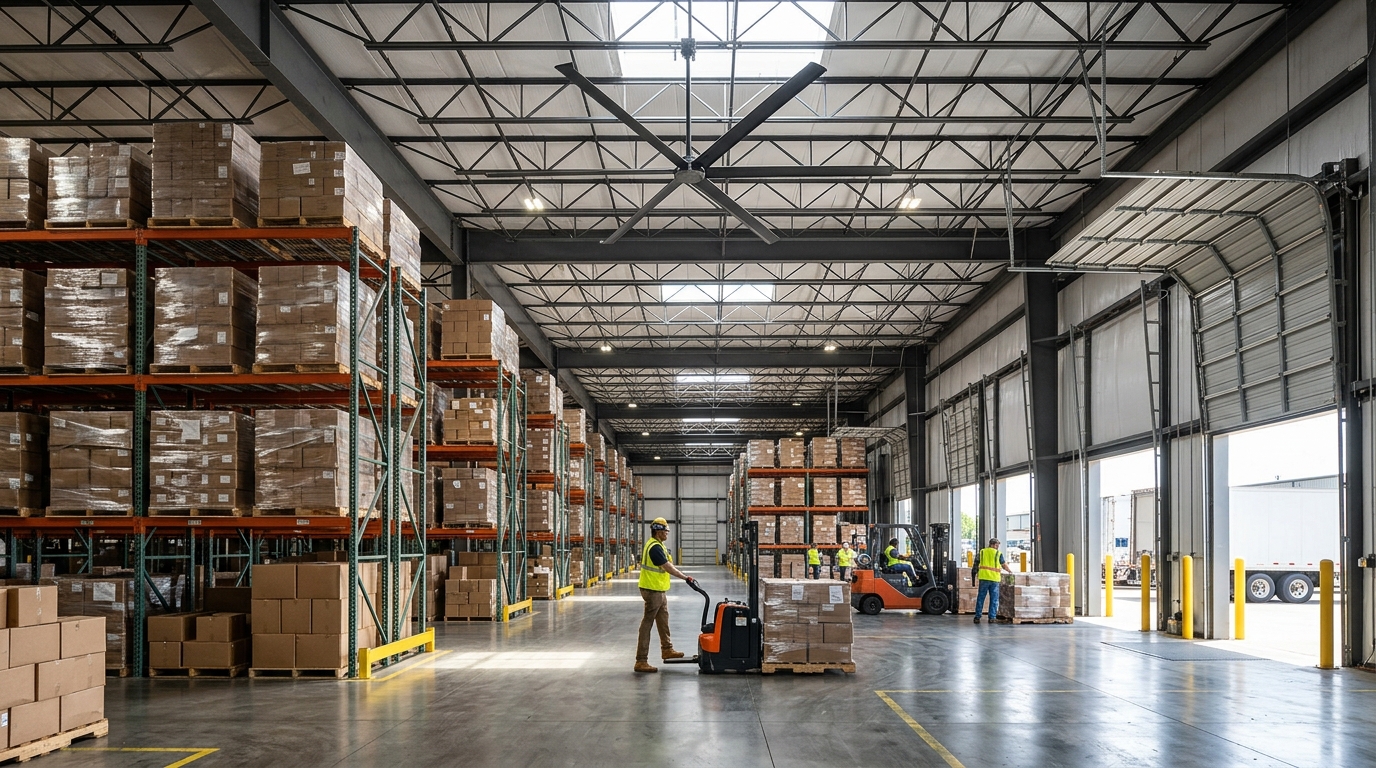
The most expensive mistake in light industrial HVAC is treating a warehouse as a single thermal zone with one big setpoint. Walk any 100,000-square-foot Birmingham distribution center during summer and the temperature differential from the dock door area to the back corner offices can be 25 degrees Fahrenheit. The dock door area sits near outdoor ambient because the doors open dozens of times a day; the back office sits at human-comfort temperature; the pick-and-pack zone sits somewhere in between, depending on activity level and product type.
Treating these as one zone fails on every dimension. Heating and cooling the dock area to office comfort wastes enormous energy and is fundamentally impossible during high door-cycling periods. Treating the back office as if it were dock area produces unhappy office staff. Treating the pick-and-pack zone with no specific design produces unhappy workers and possibly unsafe conditions during Birmingham summer heat exposure [1]. Proper zoning matches the comfort target to the operational reality of each zone.
For property managers running light industrial portfolios — distribution centers, light manufacturing, flex space — the zoning conversation is often the cheapest performance lever in the portfolio. Capital projects that add zoning, destratification fans, and dedicated dock-area systems pay back in energy savings, worker comfort, and product preservation. The trick is honest scoping of the zones rather than copy-paste design from another building type.
Most Birmingham warehouses break into four primary HVAC zones with different design targets. First, the dock door area: receiving, shipping, and the immediate buffer space inside the doors. This zone cannot be brought to office comfort during high door-cycling periods because the air exchange overwhelms any reasonable HVAC capacity. The design target is "tolerable for workers during expected shift hours" with destratification fans, dedicated heating for cold mornings, and acceptance that summer afternoons will be warm.
Second, the pick-and-pack and storage zone: the main working space where inventory is stored and workers spend the majority of their shift. The design target depends on the product. Climate-sensitive product (electronics, pharmaceuticals, certain food categories) needs tight temperature and humidity control. Climate-insensitive product allows wider tolerances and lower equipment cost. Worker comfort during summer heat waves and winter cold snaps is a real consideration regardless of product, both for productivity and for OSHA heat-illness prevention guidance [2].
Third, the office mezzanine: typically built above the dock door area or along one warehouse wall, the office mezzanine is a small conventional commercial HVAC space with its own thermostat and equipment. This zone is properly served by a small RTU or split system handling 1,500 to 5,000 square feet of office space, completely independent from the warehouse main HVAC. Trying to share equipment between the warehouse floor and the office mezzanine almost always fails — the load profiles are too different.
Fourth, the climate-sensitive product zone if one exists: temperature-controlled storage rooms for specific inventory categories. These rooms have their own equipment, often with redundancy depending on product value, and their own monitoring with temperature alarms. For Birmingham distribution centers serving pharmaceutical, electronics, or food product, this zone may be the most expensive HVAC in the building per square foot. The design follows specific industry standards (USP 1079 for pharma storage, IFT guidelines for food storage, etc.) and the equipment selection is more like cold storage than general commercial HVAC.
A warehouse dock door is the single largest infiltration source in any commercial building. Each door is 8 to 10 feet wide and 8 to 12 feet tall; when open, the air exchange is dramatic. A typical warehouse may have 10 to 30 dock doors, with high-volume days seeing each door cycle dozens of times. Birmingham summer outdoor air enters at 90+ degrees and 70+ percent humidity; winter cold air enters at 25 to 40 degrees during peak cold snaps.
Engineering responses include dock seals (foam compression seals around the door perimeter when a trailer is parked), air curtains across the door opening, and destratification fans inside the dock area to manage the stratified hot air layer that accumulates near the ceiling during summer. None of these eliminate the infiltration; they reduce it from "extreme" to "tolerable." The expectation should be that the dock area runs 10 to 20 degrees off outdoor ambient during peak conditions, not at human-comfort temperature [3].
For cold-weather operations, dock area heating is a real concern. Winter shifts working near open dock doors in Birmingham can face genuine cold exposure during January cold snaps. Properly designed dock-area unit heaters — gas-fired or electric — provide local heating to the worker positions without trying to heat the entire dock area to comfort. The design assumption is that workers experience local heat near their work station while the dock area as a whole remains cool, which is the correct engineering trade-off.
Warehouse buildings have tall ceilings and naturally stratified air. Hot air collects near the ceiling; cold air settles near the floor. In summer this stratification means the workers at floor level may feel reasonably cool while the ceiling area runs significantly hotter, but the cooling equipment has to work against the average temperature of the air mass. In winter, the stratification means expensive heated air collects near the ceiling while workers at floor level feel cold, which makes the heating system seem inadequate even though it is producing rated output.
Destratification fans solve this problem cheaply. Large-diameter ceiling fans (HVLS — high-volume low-speed — fans, typically 8 to 24 feet in diameter) operating at slow speed mix the air column without creating uncomfortable drafts at floor level. In summer this brings cooler floor air up and warmer ceiling air down, equalizing the air mass and improving cooling efficiency. In winter this brings warm ceiling air down to the floor where workers actually are, dramatically improving heating efficiency [4].
The energy economics of HVLS fans on a Birmingham warehouse are strong. Most installations recover their capital cost in 18 to 36 months on heating and cooling energy savings, plus the worker comfort improvement during peak conditions. For property managers running portfolio buildings without HVLS fans, the analysis is usually positive across the portfolio rather than building-by-building. The investment is modest and the payback is measurable.
The office mezzanine in a warehouse handles 5 to 20 office workers in a small conditioned space, often above the dock door area where the noise and forklift traffic stays outside. The load profile is conventional commercial office HVAC: people, lights, computers, with minimal solar gain because the mezzanine is enclosed within the warehouse shell. The cooling demand is modest and steady; the heating demand is modest and seasonal.
Sharing HVAC between the office mezzanine and the warehouse floor fails because the warehouse floor has dramatic load variation, infiltration from dock doors, and orders of magnitude larger volume. Any attempt to share equipment results in the office mezzanine being either over-conditioned (when warehouse load is low) or under-conditioned (when warehouse load is high). A small dedicated RTU or split system for the office mezzanine — typically 2 to 5 tons depending on size — solves this completely [5].
For property managers running multi-tenant industrial space where each tenant has a small office area within a larger warehouse, the office HVAC is typically tenant-installed and tenant-maintained. The building-level HVAC handles the warehouse floor; the tenant-level HVAC handles the office. This split works well operationally and aligns with typical industrial lease structures.
For warehouses storing pharmaceutical, food, electronics, or other climate-sensitive product, the storage zone HVAC is materially more demanding than general warehouse HVAC. Pharmaceutical storage typically follows USP General Chapter 1079 guidelines for "controlled room temperature" (20-25°C with 15-30°C excursion allowed) or "refrigerated" (2-8°C); food storage follows FDA Food Code and industry-specific guidelines; electronics storage typically requires controlled humidity to prevent ESD and condensation issues [6].
Equipment selection for these zones leans toward commercial refrigeration and dedicated HVAC platforms rather than general commercial RTUs. Redundancy is common because product loss from a single equipment failure can be enormous. Monitoring is continuous with temperature alarms tied to the property management team or third-party monitoring service. The maintenance schedule is more aggressive than general commercial HVAC, often monthly inspection cycles rather than quarterly.
For Birmingham distribution centers handling pharmaceutical product, the FDA Drug Quality and Security Act and DSCSA traceability requirements add documentation obligations. The HVAC contractor maintaining the climate-sensitive zones must produce records that satisfy auditors. Specialty refrigeration capability and documented climate-zone maintenance is a real competitive consideration when selecting a contractor for pharma-handling warehouses. Read our walk-in cooler service guide for the adjacent capability in food and grocery storage.
Three patterns repeat across the Birmingham metro light industrial work. First, the legacy warehouse with no real zoning — older buildings from the 1970s and 1980s where the entire space was treated as one big zone with rooftop unit heaters for winter and minimal cooling for summer. These buildings benefit dramatically from HVLS fan retrofits, dock-area dedicated systems, and office mezzanine separation. Capital projects on these buildings produce measurable comfort and energy improvement.
Second, the modernized distribution center with proper zoning but degraded equipment — newer buildings (1990s through 2010s) that were properly designed but where the HVAC equipment is now reaching end-of-life and the controls integration may have drifted from original specifications. The zoning concept is right; the execution has decayed. Maintenance and capital scoping here focuses on equipment replacement against the original design intent.
Third, the newer flex-space facility built for multiple potential uses — buildings constructed in the last 10-15 years with HVAC sized for a generic light industrial use that may not match the actual tenant operation. A flex space leased to a pharmaceutical distributor needs different HVAC than the same building leased to a basic warehousing operation. The zoning work may include tenant-funded capital improvement for product-specific zones, allocated under the lease structure.
Across all three patterns, the operational reality of the warehouse matters more than the equipment nameplate. The right HVAC for a warehouse is the HVAC that matches the operation; the wrong HVAC is what was installed without thinking about how the building would actually be used. Read our maintenance contract scoping guide for the PM language that builds zone-aware service into the routine work rather than treating every zone as identical.
Frequency, labor and parts inclusions, ASHRAE 180 scope, emergency tiers, and contract language to watch for b…
Office HVACWhen five people on the same floor complain about temperature but the thermostat reads 72°F, the building is t…
Property ManagementA vetting checklist any Birmingham property manager can run against any commercial HVAC contractor — including…
Commercial HVAC only. Submit the form and a dispatch coordinator follows up by email. For active outages, call (205) 206-6606.
We email confirmation within business hours. For active outages, call the line above.