Commercial HVAC · Birmingham, AL
Commercial AC Repair vs Residential HVAC — Which Tech to Call for a Birmingham Building
Published by the EHRP Commercial Desk. Anonymous field notes from Birmingham, Alabama commercial HVAC dispatch.
Published by the EHRP Commercial Desk. Anonymous field notes from Birmingham, Alabama commercial HVAC dispatch.
Commercial AC repair requires a contractor licensed under the Alabama Board of Heating, Air Conditioning, and Refrigeration Contractors with EPA Section 608 Universal certification, commercial-class diagnostic instruments, and crane or rigging access for rooftop equipment — residential HVAC techs are scoped to 1.5 to 5 ton split systems and cannot legally or safely service the 3 to 100+ ton packaged, chiller, and refrigeration equipment most Birmingham commercial buildings actually run.
The phrase "AC repair" covers two completely different mechanical worlds. On the residential side it means a 1.5 to 5 ton split system — a condensing unit on a slab outside the house, a furnace or air handler in the garage or attic, refrigerant lines between them, and a thermostat on the wall. On the commercial side it means packaged rooftop units in the 3 to 25 ton range, chiller plants from 50 to 1,500 tons, VRF multi-zone systems, walk-in cooler refrigeration with separate compressor racks, make-up air units paired with commercial kitchen exhaust, and warehouse unit heaters scattered across production-area ceilings. These are different machines with different failure modes, different refrigerant scope, different code requirements, and different licensure requirements [1, 2].
For a Birmingham facility manager calling for AC repair, this distinction matters because a residential HVAC contractor in a residential service truck cannot fix most commercial equipment. The truck inventory is wrong (residential capacitor sizes do not match commercial), the diagnostic instruments are wrong (residential clamp meters do not span commercial voltage and amperage), the refrigerant recovery equipment is undersized (residential 50-lb tanks cannot recover the 80-150 lb charges on a 15-ton commercial RTU), and the rigging is non-existent (residential trucks do not carry the lift gates, hoists, or crane access for rooftop work). Sending a residential tech to a commercial outage at minimum wastes a service call and at worst produces an incorrect diagnosis that drives a second emergency dispatch when the building is still down 24 hours later.
The licensure framework reinforces the distinction. The Alabama Board of Heating, Air Conditioning, and Refrigeration Contractors issues separate certification scopes for residential and commercial work; full commercial certification requires demonstrated commercial experience and a passing commercial-scope examination. EPA Section 608 Universal certification (required for refrigerant work on systems with charge above 5 lb) is the federal layer. Both are non-negotiable for legal commercial AC service [3].
Refrigerant scope is one of the cleanest dividing lines between residential and commercial HVAC service. Residential systems carry small refrigerant charges (typically 5-15 lb on a 1.5-5 ton split system) and almost universally run R-410A on equipment installed before 2025, transitioning to R-454B or R-32 on equipment manufactured after the January 1, 2025 AIM Act regulatory date. Section 608 leak-repair requirements technically apply to any system over 5 lb charge but the documented-repair-and-recordkeeping regime kicks in at 50 lb — well above any residential split.
Commercial equipment crosses the 50 lb threshold routinely. A 15-ton packaged rooftop unit often carries 80-150 lb of refrigerant. A VRF outdoor system can hold 60-90 lb across multi-zone piping. Commercial chillers run from 200 lb on small water-cooled units to 1,500+ lb on large centrifugal plants. Walk-in cooler refrigeration on grocery and food-service applications runs 50-200 lb across rack systems. EPA Section 608 leak-rate tracking and documentation applies to all of this, with the 20% annual leak-rate threshold (comfort cooling) or 30% threshold (industrial process) triggering documented repair within 30 days and 3-year recordkeeping [4, 5].
The practical implication for Birmingham building owners: every commercial AC service event needs to produce a refrigerant compliance documentation trail. Service ticket records refrigerant added, refrigerant recovered, and leak-check results. Annual leak-rate calculations need to be maintained for the building maintenance file. Repair-or-retire decisions when leak-rate thresholds are exceeded need to be documented within 30 days. A commercial HVAC contractor either runs this discipline or fails the compliance audit. Residential service workflows have nothing equivalent because the equipment scope does not require it. For our full breakdown, see Commercial Refrigerant Management Under the AIM Act.
For a Birmingham facility manager, the call for commercial AC repair specifically (rather than a generalist HVAC contractor) is appropriate any time the equipment is packaged rooftop, chiller, VRF, walk-in refrigeration, make-up air, or commercial kitchen exhaust — which covers essentially every commercial building. Single-family-home residential split systems serving a small office or converted residential building are the only edge case where a residential HVAC contractor might be appropriate, and even there a commercial contractor handles the work without difficulty.
Specific call-now triggers on commercial buildings: rooftop unit lockout requiring physical reset more than once in 30 days, chiller plant fault codes or alarm conditions visible on the BAS, walk-in cooler temperatures climbing above the FDA Food Code 41°F threshold or evaporator coil icing, make-up air unit failure during commercial kitchen operation, gas-fired equipment ignition lockouts or carbon monoxide alarms, refrigerant leak detection system alarms, or visible water leaks below supply diffusers indicating condensate drain failure. Any of these is commercial dispatch territory regardless of after-hours status [6].
For property management firms running multi-building portfolios, the call decision is often handled through a preventive maintenance contract that defines emergency dispatch terms ahead of time. A well-scoped PM contract names the commercial HVAC contractor, defines emergency response expectations, lists labor rates and parts markup for emergency work, and specifies the documentation requirements. This way the dispatch decision is procedural rather than ad-hoc when an outage hits. See our commercial HVAC maintenance contracts guide for the contract structure detail.
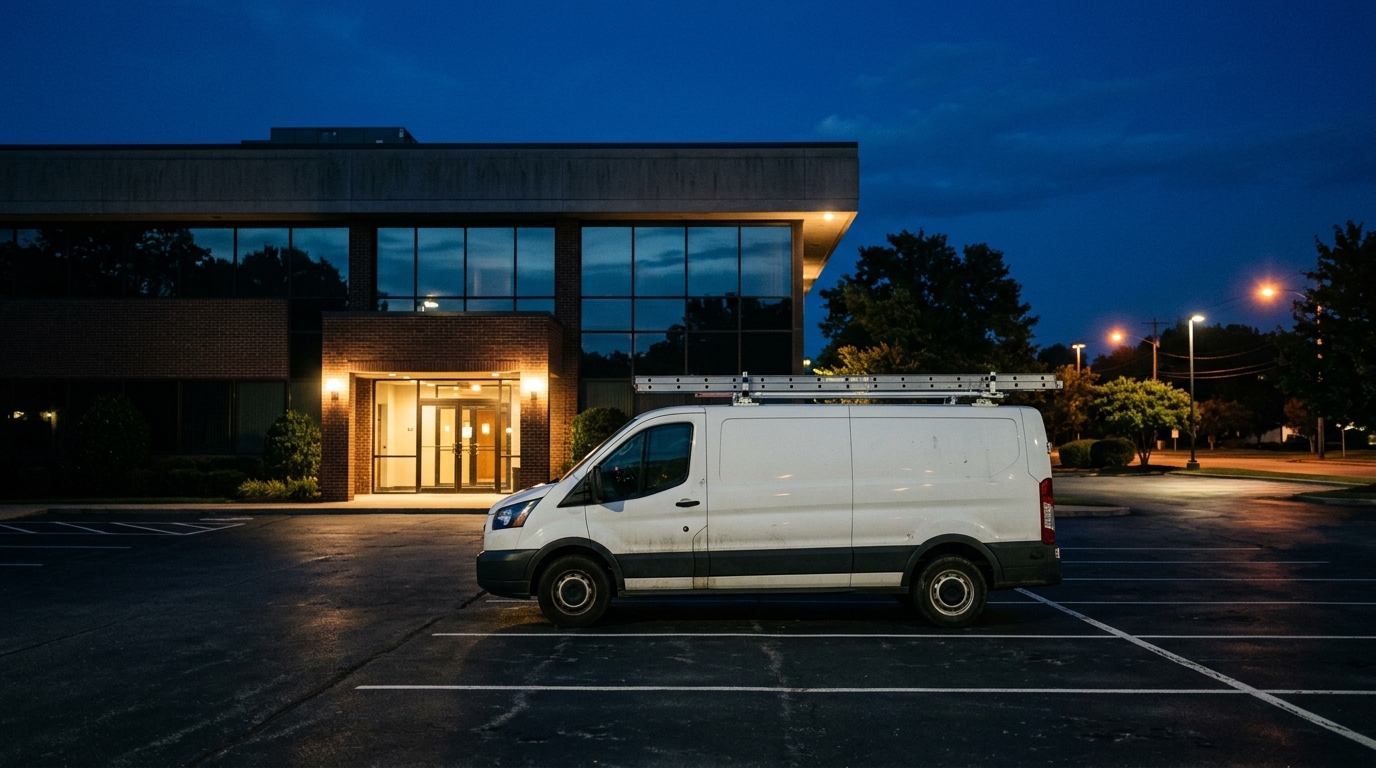
A commercial HVAC service truck rolls heavier than a residential truck. Refrigerant recovery cylinders sized for commercial charges (sometimes 200-lb cylinders, sometimes multiple 50-lb cylinders), commercial-class manifold gauges with the pressure ranges to read R-410A, R-454B, R-134a, and R-22, megohmmeters for compressor insulation testing, vibration analyzers for bearing diagnosis on commercial blowers, infrared thermal imagers for electrical and refrigerant pattern analysis, calibrated combustion analyzers for gas-side commercial work, and refrigerant leak detectors specific to A2L and lower-GWP refrigerants now coming into service.
Crane and rigging access matters on rooftop equipment. Most commercial RTU work happens on a roof. The technician needs ladder access for routine PM, but compressor or coil replacement on a 15-ton unit requires a crane to lift components on and off the roof. Commercial HVAC contractors maintain crane subcontractor relationships and roof-rigging procedures the residential side does not need. For chiller work in mechanical rooms, similar rigging considerations apply with hoists, dollies, and load-path planning through tight building corridors [7].
Diagnostic instrumentation is the third differentiator. Commercial HVAC controls integrate with building automation systems through BACnet, LonWorks, or Modbus protocols. Reading equipment fault codes through a BAS interface, troubleshooting communication failures between RTU controls and the building automation panel, and verifying sensor calibration against design setpoints all require BAS-protocol expertise that residential HVAC technicians do not develop. For VRF service, manufacturer-specific diagnostic interfaces (Daikin VRV, Mitsubishi City Multi, LG Multi V) are factory-trained-only tools that residential contractors do not carry. For our breakdown of when VRF service complexity factors into the equipment selection decision, see VRF vs Split Systems for Birmingham Mid-Rise Offices.
Alabama HVAC contractor licensure is administered by the Alabama Board of Heating, Air Conditioning, and Refrigeration Contractors at hvac.alabama.gov. The licensure framework distinguishes between residential and commercial scopes; full commercial work requires the contractor to hold a commercial scope of license, which requires demonstrated commercial experience and a passing commercial-scope examination. License lookup is publicly available at the board's website — Birmingham building managers and property managers can verify any HVAC contractor's license status, scope, and disciplinary history before signing a service contract [8].
EPA Section 608 Universal technician certification is the federal layer. Section 608 of the Clean Air Act requires technicians who handle refrigerant on systems with charge above 5 lb to hold EPA certification. The Universal level covers commercial, low-pressure, and small-appliance equipment classes — which is the level appropriate for commercial HVAC service. Type II covers high-pressure equipment (commercial RTUs and split systems), Type III covers low-pressure equipment (some chiller types), and Universal covers all of them. A commercial HVAC service event without a Section 608 certified technician is a federal Clean Air Act violation regardless of state licensure [9].
Insurance and bonding adds the third layer. Commercial HVAC contractors operating in Alabama carry general liability, workers compensation, and commercial auto insurance at limits appropriate to commercial work — typically $1M-$2M general liability, $1M commercial auto, and statutory workers comp coverage. Property managers and commercial real estate firms typically require the contractor to provide certificates of insurance and additional-insured endorsements before scheduling work on managed properties. Verifying insurance status before contracting is standard commercial-real-estate due diligence.
Commercial AC repair pricing structures differently from residential. Residential pricing is usually flat-rate by repair type (capacitor replacement, contactor replacement, refrigerant top-off) with the contractor absorbing diagnostic time into the service-call fee. Commercial pricing is typically time-and-materials with hourly labor rates that vary by trip type — straight-time, after-hours, weekend, holiday — and parts at contractor cost plus markup. The commercial structure reflects that commercial diagnostics often take longer, parts cost more, and equipment access (rooftop, mechanical room, etc.) adds time the residential structure does not have.
For Birmingham facility managers comparing service vendors, the right comparison is not raw hourly rate but total annual cost including PM contract, emergency dispatch, parts, and lifecycle planning support. A higher hourly rate from a contractor running disciplined PM and refrigerant compliance documentation can produce lower total annual cost than a cheaper hourly rate from a contractor who does not catch developing problems before they become emergency events. Pricing transparency in the contract — labor rate by trip type, parts markup percentage, after-hours surcharge, holiday surcharge — is what makes the comparison defensible.
EHRP runs commercial-only — packaged RTU, chiller, VRF, walk-in refrigeration, make-up air, commercial kitchen exhaust, and warehouse unit heaters. We do not run residential dispatch. The crew, truck inventory, diagnostic tools, refrigerant scope, and rigging access are scoped to commercial work. Contract pricing follows the time-and-materials structure with PM contract pricing scoped to the equipment inventory at your specific buildings. For a transparent breakdown of how we structure pricing, see our pricing page or request a PM quote scoped to your equipment.
Birmingham's commercial market has specifics that shape AC repair operations. The downtown core (UAB campus, federal courthouse district, Five Points South, Lakeview) runs heavily on chiller plant and central distribution. The 280 corridor through Cahaba Heights, Mountain Brook, and Inverness runs Class B office and retail with packaged RTU equipment. The 459 loop and the 65 corridor run light industrial and warehouse stock with a mix of packaged equipment, warehouse unit heaters, and process cooling. Each market segment has different equipment, different failure-mode patterns, and different dispatch-response expectations.
Birmingham summer heat — sustained dewpoint conditions through July and August with extended runtime above design temperature — is hard on commercial cooling equipment. Condenser coil fouling from pollen, humidity, and debris accelerates more here than in drier climates. Refrigerant pressures run high during peak afternoon load, which exposes marginal capacitors and contactors faster. Commercial buildings running deferred-maintenance equipment past year 12 often see their first hard failure during a sustained Birmingham summer heat wave when the marginal conditions present in spring escalate to outright failure under peak load [10].
Birmingham winters are short but cold enough — overnight lows in the teens are routine in January — that gas-fired commercial heat needs annual pre-heating-season inspection. Combustion analysis, carbon monoxide testing, gas valve verification, and ignition-control inspection all happen in the September-October window before the first cold snap. Buildings without disciplined pre-heating-season inspection are the buildings producing the November and December emergency dispatches. For multi-building Birmingham portfolios, scheduling pre-heating-season service across the portfolio in the same vendor visit window is the operational practice that prevents heating-season emergencies. Read our commercial HVAC compliance primer for the Alabama code-and-permit detail and our commercial HVAC service overview for the equipment scope we cover.
A vetting checklist any Birmingham property manager can run against any commercial HVAC contractor — including…
Commercial AC LifespanPackaged rooftop, split-system, VRF, and chiller equipment all carry different service-life curves. Lifespan r…
RTU LifecycleLife expectancy, decline indicators, replace-or-repair at year 12-15, service intervals by component, and the …
Commercial HVAC only. Submit the form and a dispatch coordinator follows up by email. For active outages, call (205) 206-6606.
We email confirmation within business hours. For active outages, call the line above.