How the lifecycle math works
ASHRAE service-life data applied to Birmingham commercial RTUs.
The short version: the ASHRAE Service Life Database gives packaged commercial rooftop units a 15 to 20 year service-life range. Maintenance frequency, climate severity, and equipment-quality tier shift that number within and around the range. This estimator runs the math in the browser using the published baseline and the field-observed adjustments.
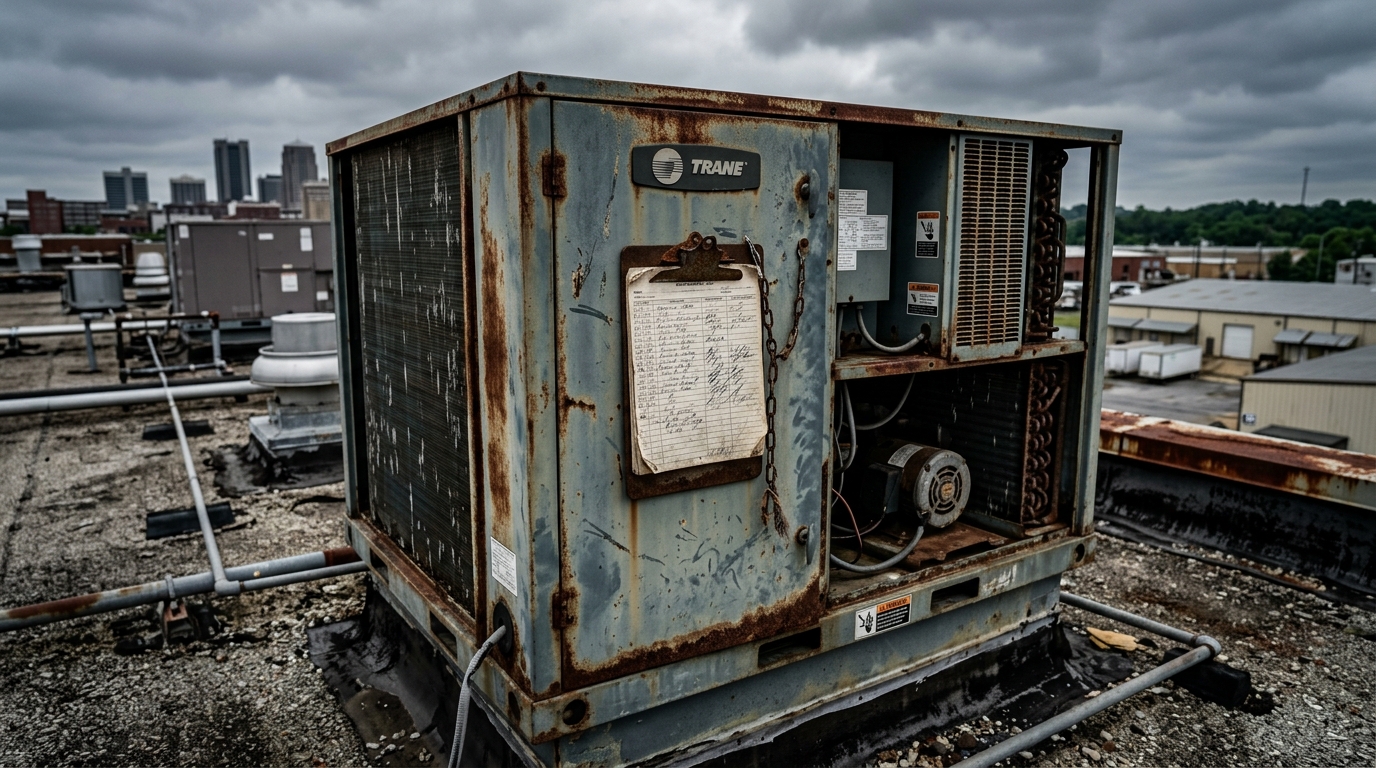
The American Society of Heating, Refrigerating and Air-Conditioning Engineers maintains the ASHRAE Equipment Service Life Database that capital planners use to model HVAC replacement cycles. The published median for a packaged commercial rooftop unit is approximately 15 years. Well-maintained equipment in moderate climates routinely reaches 18 to 20 years. Equipment running with no documented PM in severe climates often fails between years 8 and 12. The 15-to-20 band is the centerpoint that this estimator works around.
ASHRAE Standard 180 — Standard Practice for Inspection and Maintenance of Commercial Building HVAC Systems establishes quarterly preventive maintenance as the inspection frequency for packaged commercial rooftop equipment. Buildings operating under that PM scope hit the upper end of the service-life band. Buildings on annual PM hit the median. Buildings with no documented PM lose significant service life — the failure curve steepens past year 8 instead of past year 12, and capital planning is reactive instead of proactive.
Climate severity matters because the failure modes that end RTU service life are climate-driven. Compressor failure from condenser-coil corrosion is climate-driven. Evaporator-coil pinhole leaks from copper-on-copper galvanic action accelerated by humidity are climate-driven. Heat exchanger crack rates on gas-fired commercial RTUs are climate-driven. Birmingham — Köppen Cfa, ASHRAE Climate Zone 3A — sits in the worst of both worlds: high cooling-season runtime drives compressor wear, and high ambient humidity drives coil corrosion. The -2 year climate adjustment in this estimator reflects field-observed service-life data for Birmingham commercial buildings against drier or milder climates.
The estimator output drives capital planning, not emergency response. An RTU that returns "LATE LIFECYCLE — PLAN" with 2 to 4 years remaining belongs on the 5-year capital plan with a scoping conversation about replacement tonnage, refrigerant transition timing under the EPA AIM Act, and curb-adapter feasibility. An RTU that returns "END OF LIFE — DECIDE" or "PAST SERVICE LIFE" belongs in a near-term replacement decision. Read our commercial RTU lifecycle planning guide for the full year-by-year service-interval breakdown and replacement-decision framework.
This is a planning estimator, not a service diagnosis. A licensed commercial HVAC technician should physically inspect the equipment — refrigerant pressures, compressor amp draw, heat exchanger combustion analysis, control-board condition — before any replacement decision is finalized. Call (205) 206-6606 to schedule a Birmingham commercial RTU service walk.