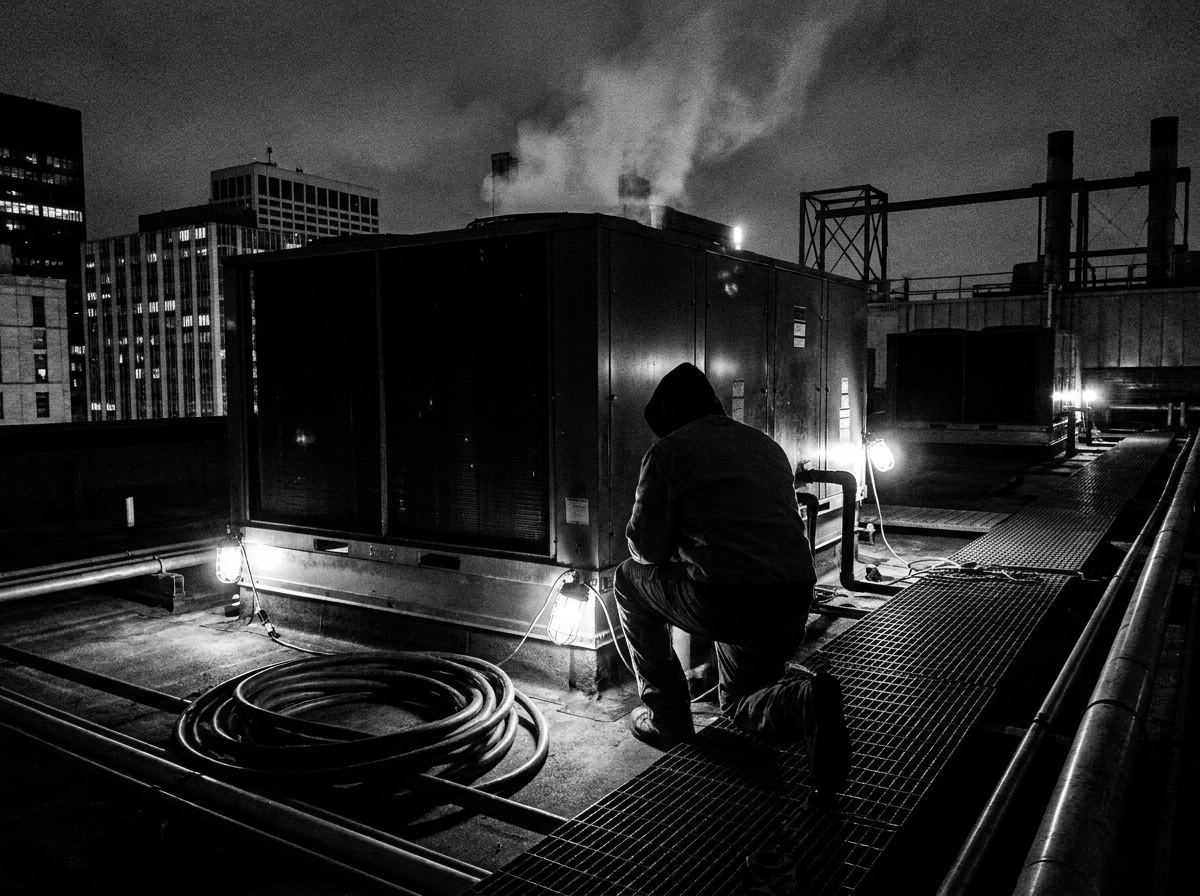
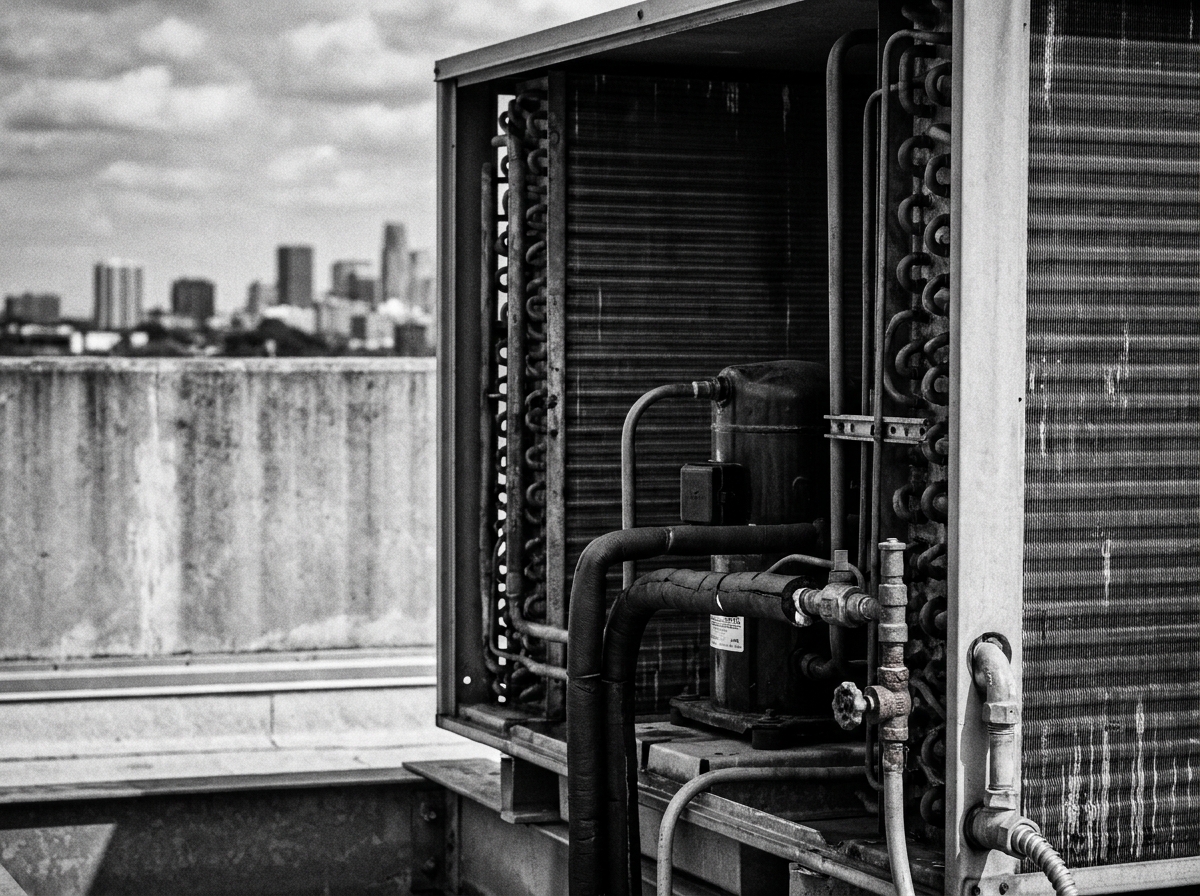
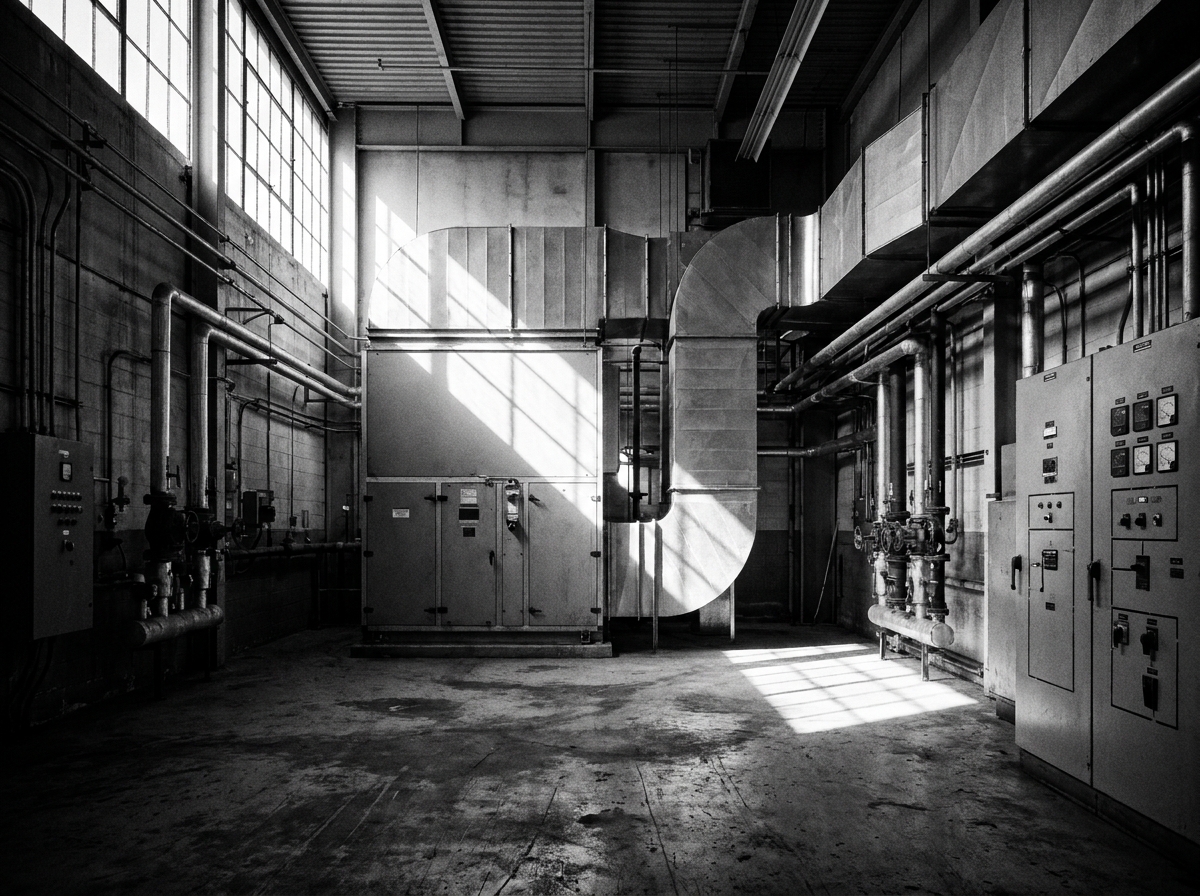
Commercial HVAC emergency service for Birmingham offices, restaurants, retail, light industrial, and property management. Commercial refrigeration services, rooftop units, air handlers, chillers, building automation. Licensed technicians. EPA Section 608. 24/7 dispatch.
Commercial HVAC service in Birmingham covers offices, restaurants, retail, industrial, and multifamily under one dispatch line — 24/7 for Jefferson and Shelby County facility teams.
If you searched commercial HVAC company near me or commercial HVAC contractor near me from a Birmingham office park, a downtown high-rise, a strip-center anchor, or a Hoover warehouse, this is the page. Emergency HVAC Repair Pros is a Birmingham-based commercial HVAC service company. We work on commercial heating and air conditioning equipment only — rooftop units, air handlers, chillers, VRF, commercial refrigeration, make-up air, building automation. We do not run residential service trucks. The dispatcher answering your call already knows the difference between a 7.5-ton RTU short-cycling on a low-voltage fault and a 25-ton chiller throwing a low refrigerant alarm.
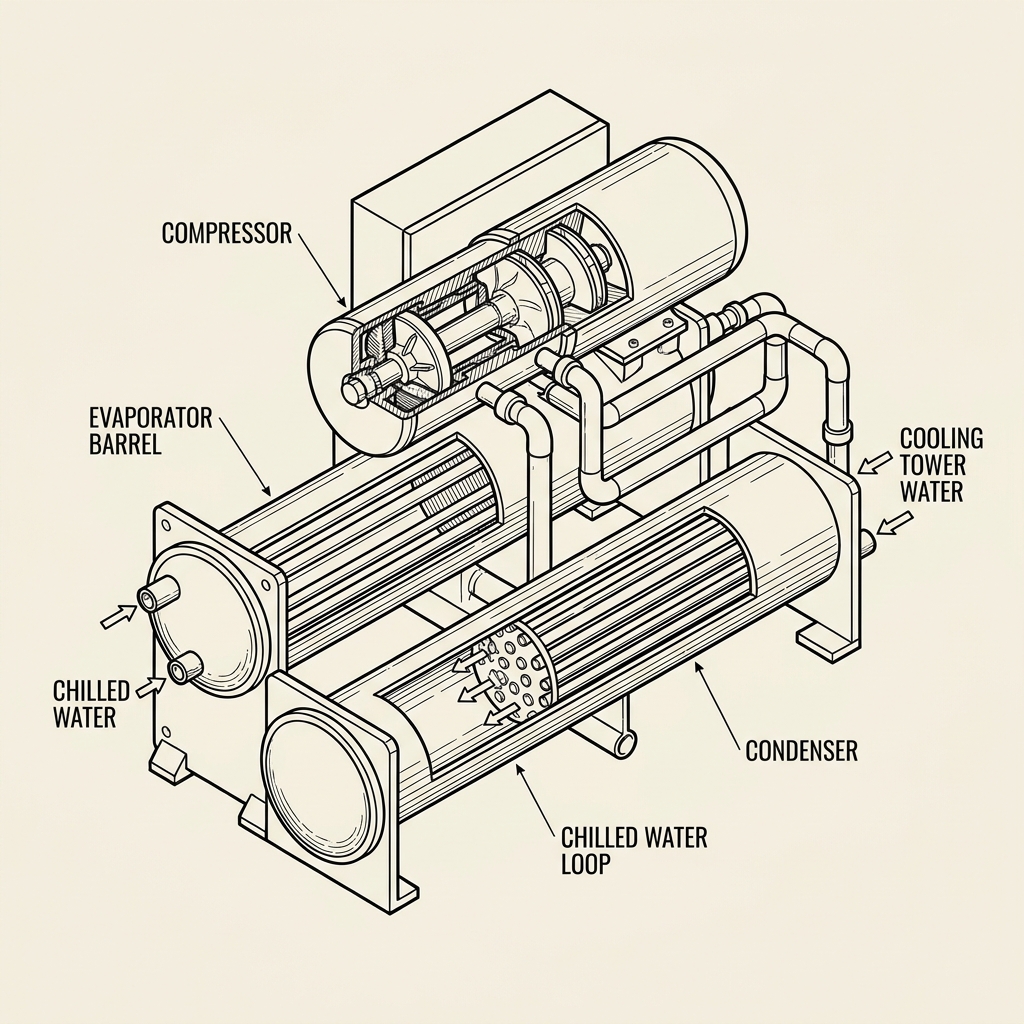
Commercial HVAC emergency service in Birmingham carries specific technical and regulatory requirements that residential service cannot meet. Commercial refrigerant systems routinely exceed the 50-pound charge threshold that triggers U.S. EPA Clean Air Act Section 608 leak-repair and reporting obligations. Centrifugal and magnetic-bearing chiller compressor platforms — Trane CenTraVac, Carrier 19DV, York YK, Daikin Magnitude — require factory training and refrigerant recovery equipment that residential contractors do not carry. Commercial rooftop units on multi-story buildings require rooftop-rated safety protocols, equipment rigging, and fall protection under OSHA 29 CFR 1910 subpart D. Commercial kitchen make-up air intersects with the NFPA 96 Standard for Ventilation Control and Fire Protection of Commercial Cooking Operations, and ventilation rates must meet ASHRAE Standard 62.1 occupancy-class targets. Source: ASHRAE 62.1, EPA Section 608.
Most national commercial air conditioning companies — Carrier, Trane, Lennox, York, Daikin — are equipment manufacturers, not service contractors. They build the commercial HVAC unit; somebody local installs it, services it, and gets it back online when it fails. We are that local crew. Form-based dispatch routing to a human coordinator, not a call-center answering service. Email-first communication building a documented paper trail for the facilities file. Itemized invoicing reconciling against property management accounts under BOMA-aligned operational reporting standards. Preventive maintenance contracts scoped to the equipment inventory of a specific building or multi-property portfolio per ASHRAE Standard 180 inspection and maintenance recommendations. Licensed technicians carrying commercial truck inventory and commercial-class diagnostic instruments — Fieldpiece combustion analyzers, Testo refrigerant leak detectors, Fluke electrical meters calibrated for commercial voltage — not residential parts scaled up. Read our maintenance-contract guide before signing a PM agreement, and review RTU lifecycle planning if you operate packaged rooftop equipment past year 10.
Coverage includes Jefferson, Shelby, and St. Clair counties from downtown Birmingham out through Hoover, Vestavia Hills, Mountain Brook, Homewood, Inverness, Trussville, Bessemer, McCalla, and the I-459, I-20, I-65 commercial corridors. Dispatch operates 24 hours a day, 7 days a week, including weekends and federal holidays. After-hours commercial dispatch is the majority of our workload — most chiller trips, walk-in cooler failures, and RTU compressor problems surface outside business hours because that is when buildings shift to unoccupied setback and equipment that was marginal during the day enters failure mode. For Alabama-specific code context, see our commercial HVAC compliance primer.
Sources and standards referenced: ASHRAE Standards 62.1, 90.1, 180, 15; ACCA Manual N; NFPA 96; U.S. EPA Clean Air Act Section 608 and AIM Act; OSHA 29 CFR 1910; BOMA commercial operations benchmarks; AHRI certification directory; Alabama Board of Heating, Air Conditioning, and Refrigeration Contractors (state licensure).
Downtown towers and suburban office parks. RTUs, chillers, VAV boxes, VRF. Facility managers and property owners as buyers.
Walk-in refrigeration, make-up air, exhaust hoods, dining-room RTUs. Owner-operators and multi-unit facilities coordinators.
Strip centers, malls, big-box. Multi-tenant RTUs, common-area cooling. Store managers and commercial property owners.
Warehouses, distribution, light manufacturing. Unit heaters, make-up air, process cooling. Plant managers and operations.
Portfolio contracts across office, retail, and multifamily. Preferred-vendor dispatch for facilities coordinators.
We service the commercial HVAC equipment classes that dominate the Birmingham commercial building stock. Truck inventory and technician training are aligned to the equipment we actually see on commercial service calls across the metro — not a scaled-up residential parts kit.
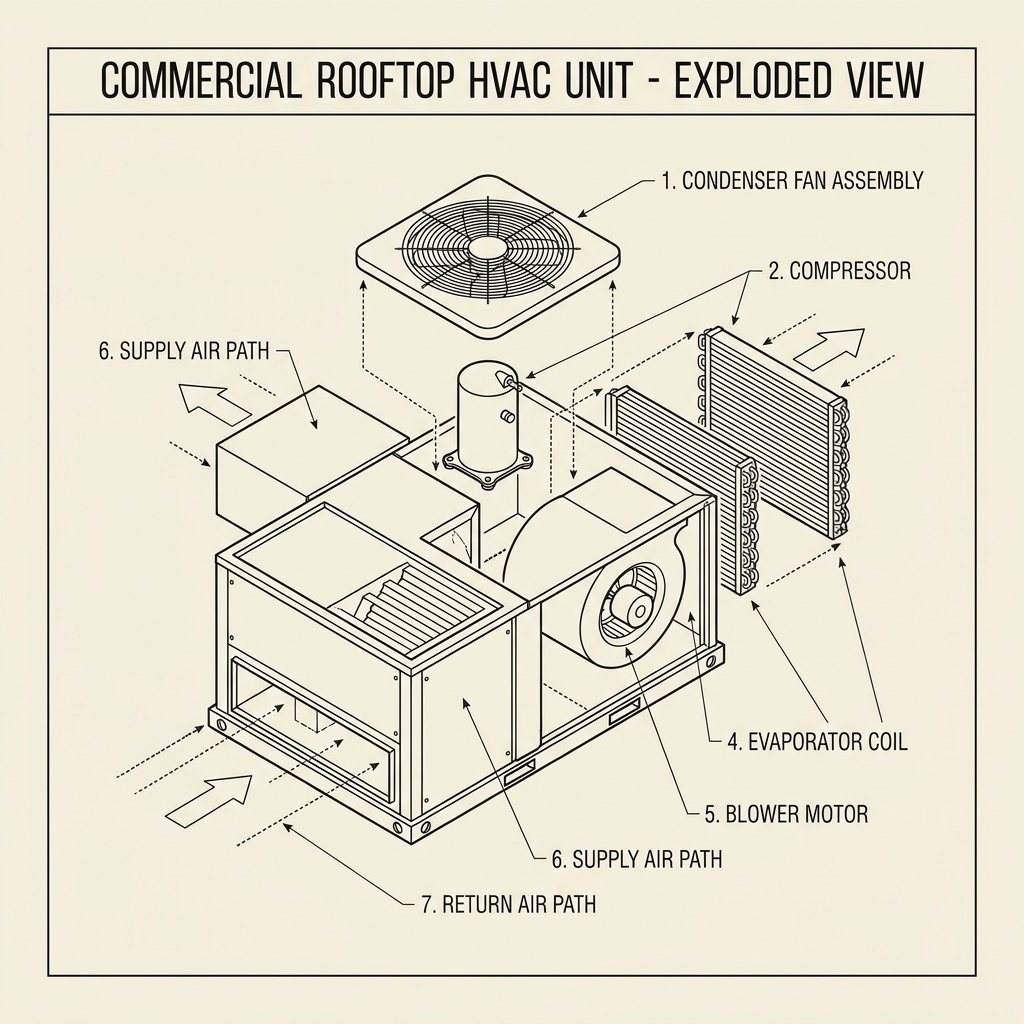
Commercial Rooftop Unit (RTU) — exploded view
Water-Cooled Chiller — system cutaway
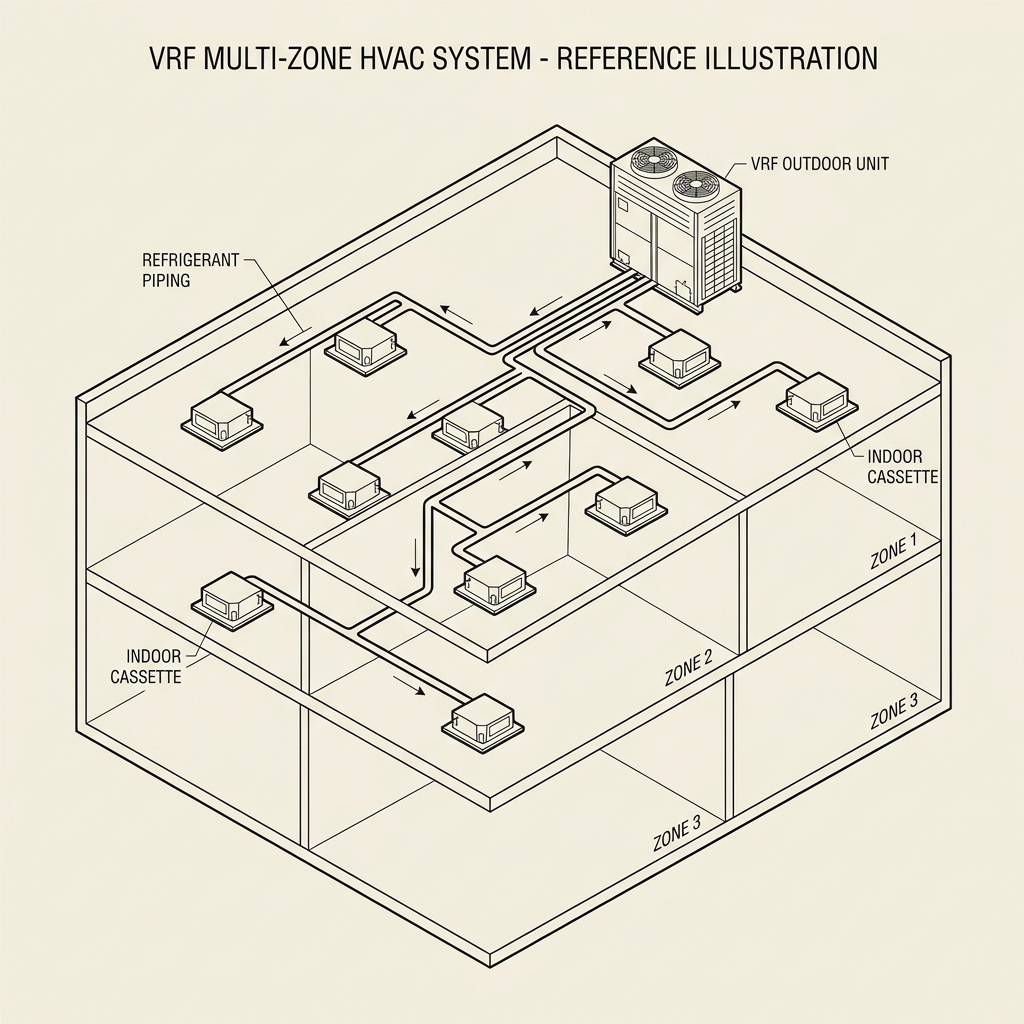
VRF Multi-Zone System — building cross-section
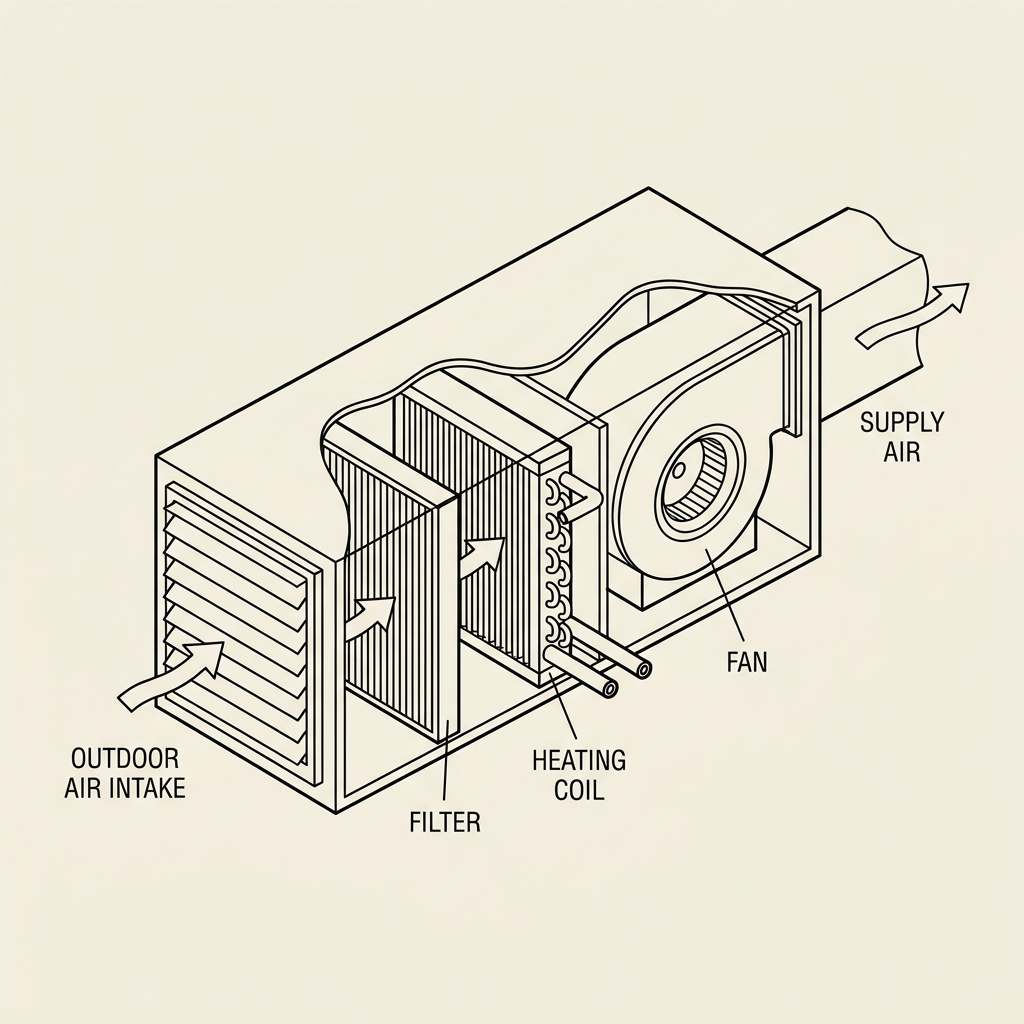
Make-Up Air Unit — airflow diagram
We do not publish response-time guarantees for commercial HVAC service. Travel time from our dispatch base, technician availability, equipment class specialization, and whether the call requires a refrigerant recovery truck all affect response. What we commit to is an honest dispatch-or-decline answer within minutes of your call so your facilities team can plan.
For after-hours commercial emergencies, the dispatch coordinator routes the call to the on-duty technician qualified for that equipment class. RTU calls go to our rooftop-rated crew. Chiller calls route to the centrifugal-certified technician. Commercial refrigeration after 9 PM routes to the refrigeration on-call. Make-up air and commercial kitchen exhaust route to the NFPA-96-familiar technician. This specialization is the reason we can actually handle the commercial work residential contractors decline.
The packaged rooftop unit is the workhorse of the Birmingham commercial building stock. Most strip centers, suburban office parks, schools, retail boxes, and small distribution buildings cool and heat with a row of commercial rooftop HVAC units sitting on a flat roof above the tenant space. A commercial rooftop unit is a single self-contained machine — compressor, condenser, evaporator, supply fan, gas heat or electric heat, economizer, and controls — bolted to a roof curb that ties straight into the supply and return ducts below. When the rooftop unit fails, the space below it loses cooling. There is no backup.
We service commercial rooftop units from 3 tons up through 75 tons. Carrier WeatherExpert, Trane Precedent and Voyager, York YHJF and Sunline, Lennox Landmark and Energence, Daikin Applied RoofPak, Rheem Renaissance, AAON RN-series, and Bryant heavy-commercial. The most common after-hours dispatch on a commercial rooftop is a compressor lockout — high-head pressure trip on a hot afternoon, low-pressure trip after a refrigerant leak, contactor welded shut, capacitor blown, or condenser fan motor seized. Our trucks carry the universal contactors, run capacitors, dual capacitors, condenser fan motors, and TXVs that solve most rooftop calls in one trip. For commercial RTU compressor replacements we coordinate refrigerant recovery on-site under EPA Section 608 and pull a recovery truck if the system charge crosses the 50-pound threshold.
Long-term ownership of a commercial rooftop is mostly about lifecycle planning, not crisis response. Manufacturer-rated service life on a packaged commercial RTU is roughly 15 to 20 years depending on tonnage class and how hard the building runs it. Past year 12 the failure curve gets steep — heat exchangers crack, evaporator coils develop slow refrigerant leaks, and the controls boards stop being available from the OEM. Read our commercial RTU lifecycle planning guide if you operate rooftop equipment past year 10. We also handle commercial rooftop replacement and curb-adapter retrofits when an old unit needs to come off and a new commercial HVAC unit drops on the same curb. For multi-unit retail and office portfolios we run scheduled rooftop preventive maintenance under our PM contracts so coil cleaning, belt service, and refrigerant verification happen before failure season.
Commercial air handlers and air handling units (AHUs) sit at the heart of split-system commercial HVAC and chilled-water buildings. The commercial air handler is the indoor side — supply fan, filter rack, cooling coil, heating coil, mixing box, and controls — that pushes conditioned air through the duct trunks into the occupied space. On larger Birmingham buildings the air handler unit lives in a penthouse mechanical room, a basement equipment room, or a dedicated mechanical closet on each floor. On chilled-water buildings the air handling unit pulls chilled water from the central plant; on DX-split buildings it pairs with an outdoor condensing unit; on dedicated outdoor air systems (DOAS) it pre-conditions ventilation air before it hits the zone equipment.
Most commercial air handler emergencies we run are blower-related. Belt-drive AHUs throw belts, slip on pulleys, lose tension, and the supply airflow collapses. Direct-drive AHUs lose ECM motors and variable-frequency drives. Coil-side problems show up as supply-air temperature drift, frozen evaporator coils, or condensate overflow. We service Trane Climate Changer, Carrier 39M and 39L, York Solution, Daikin Vision, Greenheck Vector, and Aaon air handlers. We also work on factory-built rooftop air handling units paired with split DX condensers and on built-up custom AHUs in older Birmingham office buildings. For air handler unit retrofits — coil replacement, ECM upgrade, VFD installation, MERV filter rack conversion — we scope the work against the existing duct static pressure budget so the new components actually move the design airflow.
Air handler service ties directly into ASHRAE Standard 62.1 ventilation compliance and Standard 180 inspection routines. Filters at MERV 13 minimum on most occupied commercial buildings, coil cleaning at the frequency the building's outdoor air load demands, and condensate-pan biocide treatment to prevent the microbial growth that triggers tenant complaints. We document every air handling unit visit in the facilities file with filter pressure-drop readings, supply-air temperatures, condensate-pan condition, and any belt or motor service performed.
Commercial refrigeration is its own discipline inside commercial HVAC and refrigeration work. The equipment runs colder, the refrigerants are different, and the consequences of a failure scale faster — a walk-in cooler going down at a Birmingham restaurant on a Friday afternoon is a food-loss emergency and a health-code exposure within hours. Our refrigeration repair commercial dispatch carries evaporator fan motors, condenser fan motors, defrost timers, defrost heaters, thermostatic expansion valves, refrigerant solenoids, and common compressor contactors as truck stock. We work on Hussmann, Heatcraft, Bohn, Larkin, and Russell evaporators, Copeland Discus and Scroll compressors, and Emerson and Sporlan controls.
The commercial refrigeration system service mix runs across reach-in coolers and freezers behind the bar, prep tables in the line, walk-in coolers and walk-in freezers in the back of house, ice machines on the ice line, and rack refrigeration in grocery, convenience, and food-service distribution. We also service display cases in retail bakery and meat departments. Restaurant and grocery walk-in compressor replacements, evaporator coil replacements after a refrigerant leak, and full-rack medium-temp / low-temp split systems are routine work for our refrigeration crew. For the AIM Act phasedown of high-GWP refrigerants we follow the U.S. EPA Significant New Alternatives Policy (SNAP) for any commercial refrigeration system retrofit or replacement, and we document every refrigerant transaction the way the AIM Act expects. Read our AIM Act refrigerant guide for Alabama operators.
For property managers running a mixed-use building with both commercial HVAC and commercial refrigeration on the same floor plate — the typical Birmingham strip center with a restaurant tenant and a retail tenant — one dispatch line covers both. We handle the rooftop unit cooling the dining room and the walk-in cooler keeping the protein cold. One vendor, one invoice, one set of equipment records.
Commercial automation systems are the controls layer that ties every piece of HVAC equipment in a Birmingham building into one coordinated cooling system. A commercial building automation system (BAS) — sometimes called a building management system (BMS) — schedules occupied and unoccupied modes, sequences chillers and boilers, modulates VAV terminal boxes, drives variable-frequency drives, reads space temperature and humidity from networked commercial sensors, and pushes alarms back to the facilities team when something drifts out of band. We work on Honeywell, Johnson Controls Metasys, Siemens Desigo, Trane Tracer, Carrier i-Vu, Schneider Electric EcoStruxure, Distech Controls, and Automated Logic WebCTRL. For smaller standalone commercial buildings without a full BAS, we install and service commercial thermostats and commercial programmable thermostats — Honeywell Pro, Honeywell Commercial T-series, ecobee SmartBuildings, and BAS-integrated Pelican Wireless thermostats — that handle scheduling, setback, and remote access.
Remote monitoring is the piece that pays for itself over a multi-year contract. A commercial remote monitoring tie-in lets us see refrigerant pressures, supply-air temperatures, walk-in cooler box temperatures, RTU runtime, and alarm states from off-site so a marginal compressor or a failing fan motor is caught on a trend chart instead of a 3 AM phone call. For property management portfolios across multiple buildings, central monitoring is what makes a portfolio contract worth signing — instead of managing five vendor relationships across five buildings, the facilities coordinator sees every alarm in one pane of glass.
The commercial climate control end-state we engineer toward is simple. Tenants get the comfort range the lease specifies. Equipment runs at the energy efficiency ASHRAE Standard 90.1 expects. Refrigeration boxes hold the temperatures the food-safety code demands. Facilities sees the alarms before the tenants do. We do not sell controls hardware as a profit center — we install, integrate, and service automation that actually fits the equipment in your building, and we document the sequences of operation in plain English so the next tech who walks the mechanical room can follow what the BAS is doing.
Most commercial buildings in Birmingham are running HVAC equipment installed sometime between the late 1990s and the mid-2010s. That puts the bulk of the commercial equipment stock past year 12 — past the steep part of the failure curve, deep into refrigerant phase-out exposure, and past the point where matched-coil OEM parts are reliably available. Commercial HVAC retrofit is the right work for that equipment age. We scope retrofit projects against the actual building load — sometimes the existing tonnage is wildly oversized, sometimes the original duct system is undersized for current occupancy, sometimes the controls are the only thing that needs to change. ACCA Manual N drives the load calc; ASHRAE Standard 90.1 drives the efficiency target; the building's own utility bills drive the payback math.
Replacement scopes we run regularly: rooftop unit change-outs on curb adapters, split-system condenser and air handler matched replacements, chiller replacement with a tear-out and new pad work, VRF retrofit for older 4-pipe fan-coil buildings, walk-in cooler condensing-unit replacements, and commercial boiler replacement on older office and multifamily heating plants. Boiler work covers cast-iron sectional replacements, condensing high-efficiency upgrades, hydronic loop service, expansion tank work, and combustion analysis. We coordinate any required Alabama mechanical permit work, factory-startup paperwork for warranty registration, and end-of-life refrigerant recovery documentation.
Commercial HVAC warranty work is a piece of the service mix that property managers underuse. Most commercial HVAC equipment ships with a 1-year parts-and-labor warranty and a 5-to-10-year compressor or heat-exchanger parts warranty depending on manufacturer and registration status. We pull warranty status on Carrier, Trane, York, Lennox, Daikin, Rheem, and Bryant equipment before we quote a repair, and if the failed component is a covered warranty part we file the claim and replace under warranty rather than billing the part out of pocket. For commercial HVAC products and commercial HVAC equipment manufacturers we are not factory-authorized for, we still recover, document, and replace under whatever warranty the original installing contractor carried. For temporary cooling during a long retrofit or a sudden equipment loss, we coordinate commercial portable air conditioner rental from regional rental partners — spot coolers, portable air handlers, and rental chillers when the permanent equipment is on a multi-week lead time.
If you're a Birmingham facility manager searching commercial HVAC company near me, commercial HVAC contractor near me, hvac commercial contractors near me, commercial AC companies near me, or commercial AC contractors, here is what separates this commercial HVAC service company from the pile of generic listings Google is returning. We do not run residential service trucks. Every dispatched technician is rated for commercial work — rooftop access, refrigerant recovery, commercial voltage diagnostics, NFPA 96 kitchen exhaust, BAS integration. Every truck carries commercial-class parts inventory: contactors and capacitors sized for commercial loads, evaporator and condenser fan motors in the tonnage classes Birmingham commercial equipment actually uses, refrigerant recovery scales calibrated for 50-pound-plus systems, combustion analyzers for gas-fired commercial heating equipment.
Buyer profile match is the other piece. We invoice commercial — itemized labor, itemized parts, equipment-tagged service tickets that drop straight into a facilities database. We take preferred-vendor agreements with property management firms running multi-property portfolios across Birmingham. We email-first instead of phone-first because facility managers live in their inbox and want a paper trail. We document refrigerant transactions, equipment condition reports, and warranty status the way commercial accounting departments expect. We do not pressure-sell replacement equipment, we do not run a pricing book that punishes after-hours calls, and we do not publish "free estimate" or fixed-price guarantees because honest commercial HVAC pricing depends on the equipment, the failure mode, the parts availability, and the access conditions on your building.
Air conditioning commercial service in Birmingham is a small market with a handful of legitimate commercial air conditioning companies and a much larger pool of residential outfits adding "commercial" to their websites. Heating and air commercial work is the same. The way to tell the difference is to look at what the contractor actually services on a Tuesday — if it is residential heat pumps in subdivisions, the commercial work is a side hustle. We service commercial only.
“Chiller failure at 2:47 AM. Walkthroughs scheduled for 9.”Restored before market-open.
“Walk-in cooler down at 4:15 PM Friday.”Restored the same evening.
“Make-up air failure 90 minutes before second shift.”Ambient restored before shift start.
Commercial HVAC in Birmingham operates under a layered set of standards. Our work is scoped to ASHRAE Standard 62.1 for commercial ventilation, ASHRAE Standard 90.1 for commercial energy efficiency, ACCA Manual N for commercial load calculation, NFPA 96 for commercial cooking ventilation, and EPA Clean Air Act Section 608 for refrigerant handling. Alabama HVAC licensure is the baseline for every technician on every commercial call.
Sources: ASHRAE, ACCA, NFPA, U.S. EPA, Alabama Board of Heating, Air Conditioning, and Refrigeration Contractors. Documentation available on request for facilities compliance files.
Commercial HVAC only. Submit the form and a dispatch coordinator follows up by email. For active outages, call (205) 206-6606.
We email confirmation within business hours. For active outages, call the line above.